
Overview
Forget counting reps while staring at gym walls—this article showcases ten lifestyle sports that transform dreaded exercise into thrilling adventures, from scaling rock faces and riding mountain trails to catching waves and walking slacklines. These activity-based approaches to fitness create better adherence through enjoyment, develop comprehensive physical benefits while enhancing mental wellbeing, and offer a sustainable path to fitness that feels more like play than workout obligation.
Table of Contents
- Introduction
- Why Lifestyle Sports Work for Fitness
- Rock Climbing: Vertical Fitness
- Trail Running: Nature’s Treadmill
- Mountain Biking: Terrain-Based Cardio
- Surfing: Ocean-Powered Fitness
- Paddleboarding: Core Strength on Water
- Parkour: Urban Movement Training
- Ultimate Frisbee: Team-Based Intervals
- Bouldering: Problem-Solving Strength
- Open Water Swimming: Natural Resistance
- Slacklining: Balance Mastery
- Incorporating These Sports Into Your Routine
- Conclusion
- Frequently Asked Questions
Introduction
Traditional gym workouts have their place, but lifestyle sports offer a refreshing alternative that transforms exercise from a chore into an adventure. As a sports medicine physician, I’ve witnessed remarkable transformations in patients who discover these activity-based approaches to fitness.
Lifestyle sports differ from conventional exercise by seamlessly integrating physical activity into enjoyable experiences. Instead of watching the clock during a treadmill session, you’re engaged in the thrill of catching a wave or conquering a climbing route. The exercise becomes secondary to the experience itself.
Research from the Journal of Physical Activity and Health shows that activities combining recreation with exercise lead to better adherence and long-term fitness outcomes. When you’re having fun, you’re more likely to stick with it—and consistency is the true secret to fitness success.
Why Lifestyle Sports Work for Fitness
The psychological appeal of lifestyle sports creates intrinsic motivation that traditional exercise often lacks. When was the last time you eagerly anticipated another session of bicep curls? Contrast that with the excitement of checking surf conditions or planning a mountain bike trail adventure.
This natural motivation leads to consistency—the cornerstone of fitness progress. Studies show people adhere to activities they genuinely enjoy three times longer than conventional exercise regimens. The best workout truly is the one you’ll actually do.
Beyond physical benefits, lifestyle sports deliver a triple advantage: they simultaneously develop fitness, enhance mental wellbeing through nature exposure, and foster social connections. This holistic approach creates sustainable health improvements that transcend mere physical changes.
Rock Climbing: Vertical Fitness
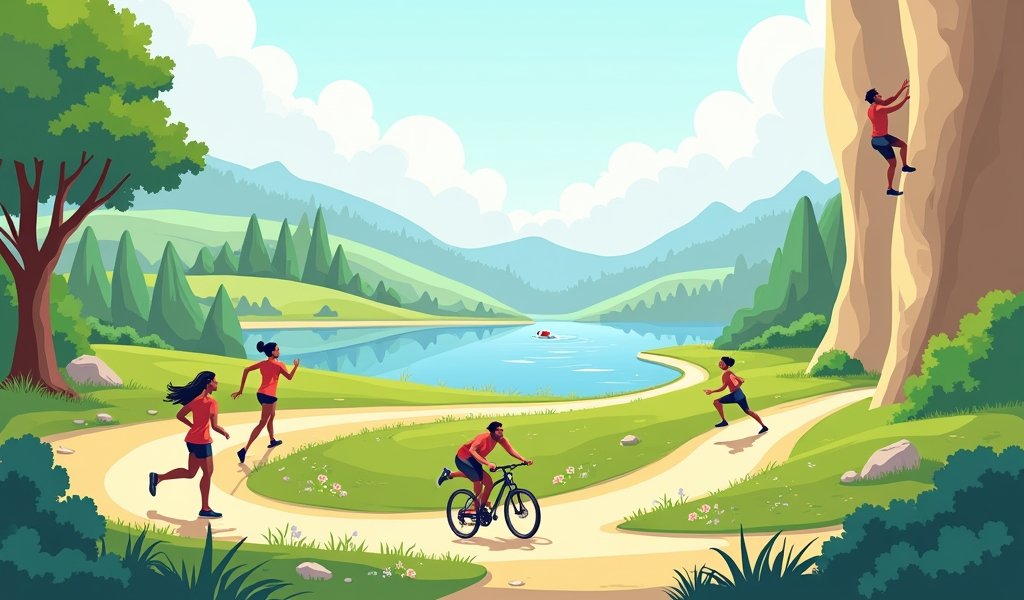
Rock climbing delivers a comprehensive full-body workout that builds functional strength while burning significant calories. Your arms pull, legs push, and core stabilizes in a synchronized movement pattern that engages nearly every major muscle group. A typical session burns between 500-900 calories per hour while developing lean, functional strength.
For beginners, indoor climbing gyms provide an ideal starting point. Most facilities offer rental equipment and introductory courses that teach fundamental techniques and safety protocols. Start with bouldering (climbing without ropes at lower heights above padded flooring) to build basic skills before progressing to rope climbing.
Within just 4-6 weeks of climbing twice weekly, expect noticeable improvements in grip strength, upper body definition, core stability, and flexibility. Many climbers report improved posture and reduced back pain as additional benefits, making climbing one of the most functionally effective forms of exercise you can do with minimal equipment.
Trail Running: Nature’s Treadmill
Unlike road running’s repetitive motion on flat surfaces, trail running introduces variable terrain that continuously challenges your body in new ways. The uneven surfaces engage stabilizing muscles in your ankles, knees, and core that remain largely inactive on pavement, creating a more comprehensive lower body workout.
The varied inclines and natural obstacles of trails force your body to adapt continuously, recruiting more muscle fibers and burning up to 10% more calories than equivalent road running. Research published in the Journal of Orthopaedic & Sports Physical Therapy suggests that the softer surfaces also reduce impact stress on joints, potentially allowing for longer-term participation with less injury risk.
For newcomers to trail running, start with well-marked, less technical trails and invest in proper trail running shoes that provide adequate traction and protection. Begin with shorter distances than you’d run on roads, and focus on time spent rather than distance covered as you build trail-specific strength and confidence.
Mountain Biking: Terrain-Based Cardio
Mountain biking delivers exceptional cardiovascular benefits while simultaneously building lower body strength. Climbing hills develops powerful quadriceps and glutes, while navigating technical terrain engages core muscles and improves coordination. The varied intensity—alternating between challenging climbs and recovery descents—creates a natural interval training effect that’s optimal for cardiovascular conditioning.
Begin with green (beginner) trails at local bike parks or nature preserves. Consider taking a basic skills clinic to learn proper body positioning and fundamental techniques. Most communities have active cycling communities where beginners can find mentorship and group rides matched to their ability level.
Regular mountain bikers develop exceptional lower body strength, improved cardiovascular endurance, and enhanced balance. After 2-3 months of consistent riding (2-3 times weekly), most beginners report significant improvements in overall stamina and notable leg definition. The sport’s technical nature keeps the mind engaged while the body works, making long rides feel less like exercise and more like adventure.
Surfing: Ocean-Powered Fitness
Few activities engage the entire body as comprehensively as surfing. Paddling develops upper body endurance and shoulder stability, the pop-up movement builds explosive strength, and riding waves challenges core stability and lower body control. A 2-hour surf session can burn 400-800 calories while developing functional strength throughout the body.
Surfing does have one of the steeper learning curves among lifestyle sports. Begin with a larger, more stable board and professional instruction. Accept that your first sessions will involve more paddling and falling than actual wave-riding—but even these “failures” are burning significant calories and building paddling strength.
Dedicated surfers develop a distinctive physique characterized by strong shoulders, defined core muscles, and exceptional rotational strength. Beyond physical changes, research in the European Psychiatry Journal indicates that regular ocean immersion contributes to improved mood states and reduced symptoms of anxiety and depression.
Paddleboarding: Core Strength on Water
Stand-up paddleboarding (SUP) creates an unstable platform that forces continuous core engagement simply to remain upright. Every paddle stroke involves rotational movements that strengthen obliques and back muscles, while the constant small adjustments to maintain balance develop proprioceptive awareness and stabilizing muscles throughout the body.
Among water sports, paddleboarding offers one of the gentlest entry points. Most beginners can stand and paddle effectively within their first session, especially on calm waters. Rental boards are widely available at lakes, rivers, and coastal areas, making this an excellent option for fitness-minded travelers or those wanting to test the activity before investing in equipment.
As skills advance, explore different paddling environments (open ocean, rivers, surf breaks) or try specialized variations like SUP yoga or racing. Each progression introduces new physical challenges while maintaining the meditative quality that makes paddleboarding so appealing for stress reduction and mental clarity.
Parkour: Urban Movement Training
Parkour transforms the urban landscape into a comprehensive gym by using walls, rails, and structures for movement challenges. Practitioners develop exceptional power-to-weight ratio, spatial awareness, and functional mobility applicable to daily life. It’s physical training that translates directly to real-world capability.
Begin with a qualified instructor who emphasizes progressive skill building and proper landing techniques. Many cities now have dedicated parkour gyms that provide padded surfaces for learning fundamentals before taking skills outside. Focus initially on basic movements like precision jumps, safety rolls, and vaults before attempting more complex combinations.
Regular parkour practice creates a distinctively capable physique with strong shoulders, powerful legs, and exceptional core control. Beyond muscle development, practitioners report improved confidence in movement and reduced fear of physical challenges—benefits that transfer to numerous aspects of daily life and other athletic pursuits.
Ultimate Frisbee: Team-Based Intervals
Ultimate Frisbee combines the continuous movement of soccer with the aerial skills of football into a non-contact sport that delivers exceptional cardiovascular benefits. The sport’s requirement for quick directional changes, sprinting, and jumping develops agility and power while the focus on play keeps participants engaged far longer than traditional interval training.
Few lifestyle sports offer the immediate social connection of Ultimate. The sport’s self-officiating nature fosters communication, while the team structure creates accountability that enhances consistency. For those who find solitary exercise unmotivating, the social nature of Ultimate provides built-in workout partners and friendly competition.
Visit UltimateFrisbee.org to locate established leagues, or check university campuses and city parks on weekends for pickup games. Most communities welcome beginners, often providing informal coaching during play. The sport’s inclusive culture makes it particularly accessible for fitness seekers who are intimidated by more competitive team sports.
Bouldering: Problem-Solving Strength
Bouldering strips climbing down to its essential elements—just you, the rock, and puzzles requiring both physical strength and mental strategy. The activity develops exceptional upper body strength, grip endurance, and core stability while engaging problem-solving parts of the brain. It’s physical chess that builds both body and mind.
Begin at indoor bouldering gyms where problems (climbing routes) are clearly marked by difficulty and landing areas are safely padded. As skills progress, outdoor bouldering introduces natural rock features and the joy of climbing in natural settings, though this requires additional equipment (crash pads) and ideally experienced companions.
Bouldering progress comes in satisfying bursts of achievement. You’ll likely advance through several difficulty grades in your first few months as technique improves and specific strength develops. Many boulderers report noticeable changes in upper body definition within 6-8 weeks of regular (2-3 times weekly) sessions, making it one of the most efficient ways to develop functional upper body strength without traditional weights.
Open Water Swimming: Natural Resistance
Unlike pool swimming, open water immersion adds elements of current, waves, and temperature that significantly increase caloric expenditure. The absence of walls eliminates rest periods, creating a true endurance challenge that builds remarkable cardiovascular capacity. The water provides natural resistance in all directions, creating balanced muscle development throughout the body.
Few activities build psychological resilience like open water swimming. Facing changing conditions and the vastness of natural bodies of water develops a calm approach to challenges that transfers to daily life. Many practitioners report improved stress management and enhanced ability to remain composed in difficult situations.
Begin in controlled environments with supervision. Many coastal communities offer guided group swims with experienced leaders who can teach essential skills like sighting (navigating while swimming) and managing changing conditions. Always swim with a companion or in organized groups until you’ve developed substantial experience and confidence in various conditions.
Slacklining: Balance Mastery
Slacklining—walking on a tensioned flat webbing between two anchor points—creates an unstable surface that forces remarkable core engagement and develops proprioceptive awareness. The micro-adjustments required activate stabilizing muscles throughout the body, particularly in the lower legs and torso.
Basic slackline kits cost $50-100 and can be quickly set up between trees in parks or yards. Begin with the line relatively low (12-18 inches) over soft ground or grass, gradually increasing height as confidence develops. Many communities have slackline groups that gather in parks where you can try the activity before purchasing equipment.
Most beginners start by simply trying to stand on the line with assistance, progressing to independent standing, walking, turning, and eventually performing static poses or dynamic movements. Each stage brings new balance challenges and corresponding fitness benefits, particularly to core strength and ankle stability—attributes that transfer well to nearly all other sports and daily activities.
Incorporating These Sports Into Your Routine
Create a year-round fitness calendar by selecting complementary activities that shine in different seasons. Mountain biking and trail running excel in spring and fall, water sports dominate summer, while indoor climbing and bouldering provide winter alternatives. This seasonal approach prevents burnout while maintaining consistent activity levels throughout the year.
Combine activities that develop different fitness attributes for a comprehensive approach. The upper body strength from climbing pairs perfectly with the lower body focus of mountain biking. The balance skills from slacklining transfer directly to surfing and paddleboarding. By thoughtfully pairing complementary activities, you create a well-rounded fitness program disguised as recreation.
For optimal fitness gains, aim to participate in your chosen lifestyle sports 3-4 times weekly, with at least two different activities in rotation. This frequency provides sufficient stimulus for physical adaptation while allowing adequate recovery between sessions. Remember that consistency trumps intensity—regular moderate participation yields better long-term results than occasional extreme efforts.
Conclusion
The transformative power of lifestyle sports lies in their ability to shift fitness from obligation to anticipation. When you’re checking surf forecasts instead of watching the clock during workouts, you’ve discovered the sustainable path to fitness that has eluded so many gym-membership optimists.
Each of these ten activities offers unique physical benefits wrapped in the joy of skill mastery and often the bonus of community connection. The strongest fitness routine isn’t built on willpower but on genuine enthusiasm for the activities themselves.
As health professionals, we’ve witnessed countless fitness journeys transformed when people shift from exercise programs they tolerate to physical activities they love. I encourage you to select at least one sport from this list that sparks your interest and give it a genuine try. Your body will receive the benefits of movement while your mind experiences the refreshing shift from “having to exercise” to “getting to play.”
Remember that the most effective fitness program isn’t the one with the most scientific periodization or the fanciest equipment—it’s the one that makes you forget you’re exercising at all.
Frequently Asked Questions
Which lifestyle sport burns the most calories?
Surfing, mountain biking, and trail running typically burn the most calories, ranging from 600-900 calories per hour depending on intensity. The exact caloric expenditure varies based on effort level, environmental conditions, and individual metabolism.
Are lifestyle sports suitable for beginners with no athletic background?
Yes, many lifestyle sports have graduated entry points suitable for complete beginners. Start with paddleboarding on calm water, indoor bouldering, or beginner trail running to build foundational fitness while developing sport-specific skills.
How much do I need to invest to get started with lifestyle sports?
Initial investment varies widely, from nearly free (trail running, ultimate frisbee) to moderate (slacklining, bouldering) to higher investment (mountain biking, surfing). Many activities offer rental equipment, allowing you to try before investing in gear.
Can lifestyle sports replace traditional gym workouts entirely?
For many people, yes. A well-rounded selection of lifestyle sports can develop all components of fitness: cardiovascular endurance, strength, flexibility, balance, and power. Some athletes may still benefit from supplemental strength training for specific goals.
How quickly will I see fitness results from lifestyle sports?
Most participants notice initial improvements in endurance, mood, and energy levels within 2-3 weeks. Physical changes like muscle definition and weight management typically become apparent after 6-8 weeks of consistent participation (3+ times weekly).