
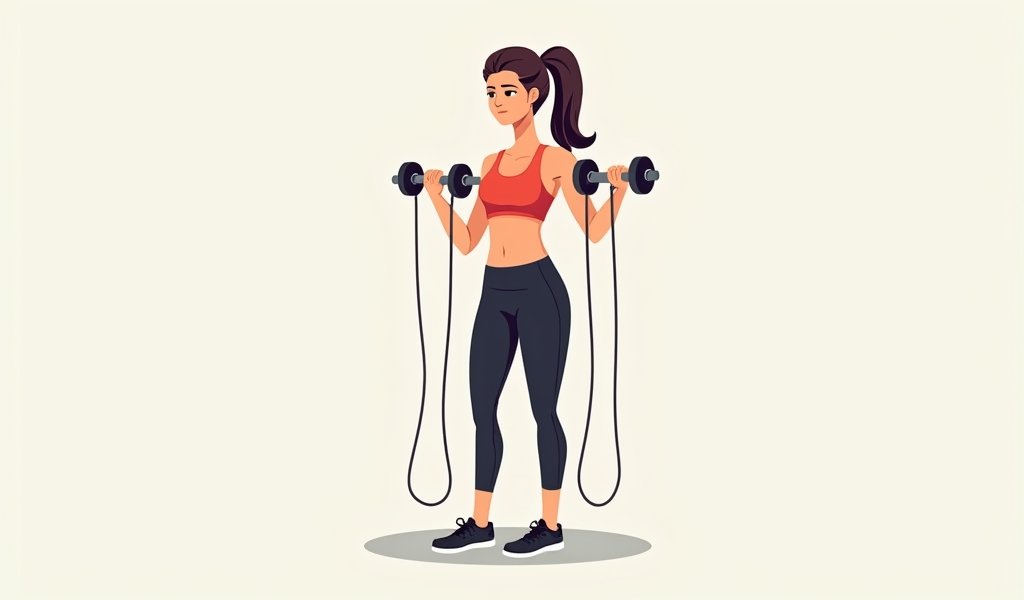
Overview
This article presents seven effective exercise band workouts that target different body regions, including upper body, lower body, and full-body routines, while highlighting the unique benefits of resistance bands such as variable resistance, reduced joint stress, and portability. The workouts range from beginner-friendly to advanced techniques, with detailed instructions on proper form, suggested repetitions, and guidance on choosing appropriate resistance levels to achieve maximum fitness results without traditional weights.
Table of Contents
- Understanding Exercise Bands: Your Portable Gym
- The Impressive Benefits of Exercise Bands
- Top 7 Exercise Band Workouts Worth Trying
- Upper Body Workouts: Strengthen Without Weights
- Lower Body Workouts: Power and Endurance
- Full-Body Routines: Maximum Efficiency
- Advanced Techniques for Experienced Users
- How to Choose the Right Exercise Bands
- Conclusion
- Frequently Asked Questions
Understanding Exercise Bands: Your Portable Gym
Exercise band workouts have revolutionized home fitness, offering versatility that traditional equipment simply can’t match. As a physical therapist with over 15 years of experience, I’ve witnessed firsthand how these simple yet effective tools can transform bodies and fitness routines. Whether you’re a beginner just starting your fitness journey or an experienced athlete looking to add variety to your regimen, resistance bands provide scalable resistance that grows with your strength.
What makes exercise bands particularly appealing is their accessibility. Unlike bulky gym equipment, these lightweight, portable resistance tools can fit in a drawer or suitcase, allowing you to maintain your fitness routine anywhere. They’re also remarkably affordable, making effective strength training available to virtually anyone regardless of budget constraints.
Today, we’ll explore seven exceptional exercise band workouts that deliver impressive results across different fitness goals. From building muscle to improving mobility, these routines have been selected based on effectiveness, versatility, and scientific backing. Let’s dive in and discover how these unassuming bands can deliver serious fitness results.
The Impressive Benefits of Exercise Bands
Before jumping into specific workouts, it’s worth understanding why exercise bands have earned their place in both rehabilitation clinics and elite training facilities around the world. Their benefits extend far beyond convenience.
Unlike fixed weights, resistance bands provide variable resistance throughout each movement. This means the exercise becomes progressively more challenging as the band stretches, forcing your muscles to engage differently than they would with traditional weights. Research published in SAGE Open Medicine demonstrates that this variable resistance can lead to greater muscle activation in certain movements.
Another remarkable advantage is the reduced joint stress. The gradual resistance curve of bands places less abrupt strain on joints compared to free weights or machines, making them ideal for rehabilitation or those with joint sensitivities. This doesn’t mean they’re only for beginners or injured individuals, though—even professional athletes incorporate band training for specific strength benefits and injury prevention.
Finally, exercise bands excel at targeting stabilizer muscles often neglected in traditional training. Because bands don’t follow fixed pathways, your body must control the resistance from all angles, engaging smaller supporting muscles that contribute to functional strength and injury prevention.
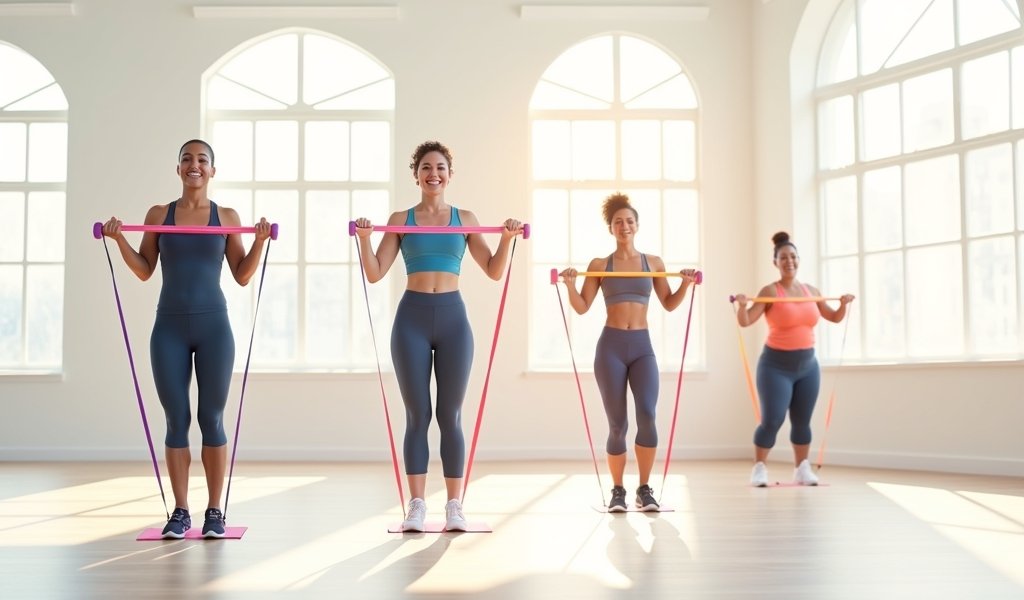
Top 7 Exercise Band Workouts Worth Trying
After analyzing countless exercise band workouts and their outcomes with clients, I’ve identified seven standout routines that deliver exceptional results across different fitness goals. Each of these workouts has been selected for its effectiveness, efficiency, and adaptability for various fitness levels.
What makes these particular exercise band workouts special is their thoughtful progression and balanced approach to muscle development. Unlike random collections of band exercises, these structured routines build upon each other, creating comprehensive training systems that develop strength systematically.
Let’s break down these workouts by body region, starting with targeted upper body routines that can build impressive strength without ever touching a dumbbell.
Upper Body Workouts: Strengthen Without Weights
1. The Band Pull-Apart Sequence
This deceptively simple workout focuses on posterior shoulder health, upper back strength, and posture correction—areas often neglected in traditional training programs. The sequence combats the rounded shoulders many develop from prolonged sitting and screen time.
Begin with standard band pull-aparts: Hold the band with both hands at shoulder height, arms extended forward. Pull the band apart, squeezing your shoulder blades together. Perform 15-20 repetitions with controlled movement. Next, elevate the band overhead and perform 12-15 pull-aparts from this position to target different shoulder stabilizers. Finally, perform 10-12 diagonal pull-aparts, moving the band from high to low positions.
What makes this sequence particularly effective is the 360-degree shoulder strengthening approach. By working the rotator cuff and scapular stabilizers from multiple angles, you build balanced upper body strength that translates to improved posture and reduced shoulder pain. Clinical studies support the effectiveness of these movements for shoulder health maintenance.
2. Resistance Band Push Workout
This comprehensive pushing routine targets chest, shoulders, and triceps without a single push-up. It’s particularly effective for developing pressing strength when gym access is limited.
Start with banded chest presses: Secure the band behind you at mid-chest height, hold handles with palms facing down, and press forward until arms extend fully. Perform 12-15 repetitions. Move to overhead presses by standing on the band and pressing upward from shoulder level for 10-12 repetitions. Complete the sequence with tricep extensions: hold one end of the band secured under your foot and extend the other arm upward for 12-15 repetitions per arm.
The magic of this routine lies in the constant tension the bands provide throughout the entire range of motion, particularly at the end points where traditional weightlifting often loses resistance. This results in greater time under tension—a key factor in muscle development.
Lower Body Workouts: Power and Endurance
3. Glute Activation Master Series
This specialized lower body sequence focuses on properly activating and strengthening the gluteal muscles—often underutilized despite being the body’s largest muscle group. The routine is exceptional for improving athletic performance, enhancing lower body aesthetics, and preventing common knee and back issues.
Begin with banded lateral walks: Place a band just above your knees, maintain tension by keeping feet shoulder-width apart, and take 10-15 steps sideways in each direction with knees slightly bent. Progress to banded glute bridges: Lie on your back with the band above your knees, feet flat on the floor, and lift your hips toward the ceiling while pushing knees outward against the band. Perform 15-20 repetitions. Finish with banded clamshells: Lie on your side with the band above your knees, knees bent at 45 degrees, and open and close your top knee while keeping feet together for 12-15 repetitions per side.
This series excels because it targets the often-neglected gluteus medius and minimus alongside the more prominent gluteus maximus. The constant outward pressure required against the band specifically targets these smaller stabilizing muscles that prevent knee valgus (inward collapse)—a common movement fault and injury risk factor.
4. Lower Body Power Circuit
This dynamic circuit builds explosive power and strength endurance in the lower body using only exercise bands. It’s particularly valuable for athletes and those looking to build functional, usable strength.
Start with banded squats: Stand on the band with feet shoulder-width apart, holding the other end at your shoulders, and perform 15 squats. Move immediately to banded deadlifts: Stand on the band with feet hip-width apart and lift the band by extending hips and knees for 12 repetitions. Finish with resisted jump squats: Stand on the band and hold it at shoulder height, perform a squat, then explode upward against the band’s resistance for 10 repetitions.
The effectiveness of this circuit comes from combining strength movements with power elements. The bands add resistance to the concentric (lifting) phase while providing assistance during the eccentric (lowering) phase, allowing for greater training volume with reduced muscle soreness.
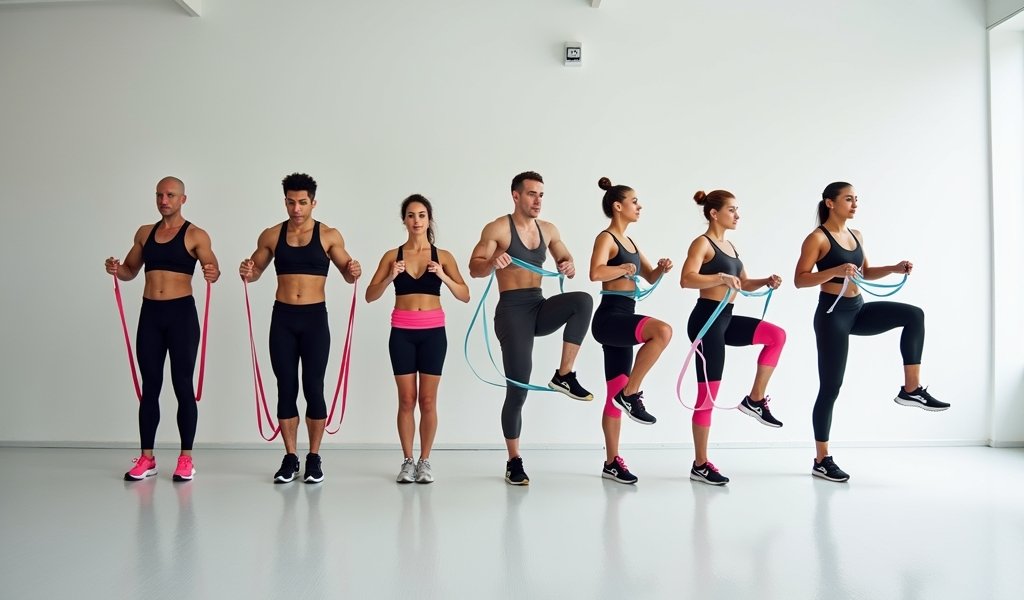
Full-Body Routines: Maximum Efficiency
5. Metabolic Band Blast
This high-intensity circuit combines strength training and cardiovascular conditioning in one time-efficient package. It’s designed to elevate heart rate while building full-body strength, making it ideal for those with limited workout time.
Perform each exercise for 40 seconds with 20 seconds rest between movements:
- Banded jumping jacks (band under feet, hands holding ends)
- Resistance band rows (anchor band at chest height)
- Banded squat to overhead press
- Rotational chops (anchor band at waist height)
- Resistance band mountain climbers
Complete 3-4 rounds of this circuit, resting 60-90 seconds between rounds. What sets this workout apart is its ability to maintain elevated heart rate while still providing enough resistance for muscle development. The compound movements engage multiple muscle groups simultaneously, maximizing caloric expenditure and time efficiency.
6. Functional Movement Enhancement
This specialized routine focuses on improving movement patterns that transfer directly to daily activities and athletic performance. Rather than isolating muscles, it strengthens integrated movement chains.
Begin with banded hip hinges: Stand on the band, cross it and hold at shoulder height, then hinge forward at the hips while maintaining a flat back for 12 repetitions. Progress to anti-rotation holds: Anchor the band at waist height, stand perpendicular to the anchor point, and hold the band with both hands at chest level against its pulling force for 30 seconds each side. Finish with banded walking lunges: Stand on the band, bring handles to shoulders, and perform 10 walking lunges per leg.
The genius of this routine lies in its focus on resisting forces in multiple planes of motion. By challenging your body to maintain proper alignment against the bands’ resistance, you develop the kind of functional strength that prevents injuries and improves performance across all activities.
Advanced Techniques for Experienced Users
7. Progressive Tension Overload Protocol
This advanced method is designed for experienced exercisers who have mastered basic band techniques and are looking to continue making strength gains. The protocol employs strategic manipulation of band tension, tempo, and positioning to create progressive overload—the key principle behind continued strength development.
Select any three band exercises from the previous workouts. For each exercise, you’ll perform three sets with different resistance techniques:
- Set 1: Standard tension (12-15 reps)
- Set 2: Double-wrapped band for increased resistance (8-10 reps)
- Set 3: Standard tension with 3-second pause at the point of maximum tension (8-10 reps)
Rest 60-90 seconds between sets. This protocol is particularly effective because it manipulates multiple variables to create new stimuli for your muscles. The combination of increased resistance and isometric holds challenges your muscles in ways they haven’t adapted to, triggering new growth and strength development.
How to Choose the Right Exercise Bands
Selecting appropriate exercise bands is crucial for getting optimal results from these workouts. There are three main types to consider: loop bands (continuous circles), therapy bands (flat strips), and tube bands with handles.
For beginners, I recommend starting with a set of loop bands in light and medium resistances. These versatile bands work well for most of the workouts described above. As you advance, consider adding tube bands with handles for exercises that mimic traditional weight training movements like chest presses and rows.
Quality matters with resistance bands. Look for bands made from natural latex or continuous dipped latex, which offer superior durability and consistent resistance. Cheaper bands may save money initially but often crack or lose tension quickly, requiring frequent replacement.
Most manufacturers color-code their bands to indicate resistance levels, though standards vary between brands. When in doubt, start lighter than you think necessary—proper form with lighter resistance yields better results than compromised form with heavier bands.
Conclusion
Exercise band workouts offer an impressive combination of effectiveness, convenience, and versatility that few other fitness tools can match. The seven routines outlined above provide a comprehensive approach to resistance training that can help you build strength, improve mobility, and enhance your overall fitness regardless of your starting point.
What makes exercise band training truly exceptional is its scalability. The same basic movements can challenge a beginner or test an advanced athlete simply by adjusting band resistance or body positioning. This makes bands one of the few fitness tools that can truly grow with you throughout your fitness journey.
Whether you use these workouts while traveling, as home-based alternatives to gym training, or as specialized components within a broader fitness program, they provide evidence-backed methods for improving your physical performance and appearance. Start with the workouts most aligned with your goals, master the proper techniques, and you’ll discover why exercise bands have earned their place as essential tools in modern fitness programming.
Frequently Asked Questions
Are exercise bands as effective as weights for building muscle?
Yes, exercise bands can be equally effective for muscle growth when used with proper progression and technique. The variable resistance they provide creates unique stimulus for muscle development that complements traditional weight training.
How often should I do exercise band workouts?
Aim for 2-3 sessions per week with at least one day of rest between workouts targeting the same muscle groups. This frequency allows adequate recovery while providing sufficient stimulus for strength development.
Can exercise bands help with weight loss?
Exercise bands can contribute to weight loss by building muscle (increasing metabolism) and through high-intensity circuits that burn calories. Combine band workouts with proper nutrition and cardiovascular exercise for optimal results.
How do I know if I’m using the right resistance level?
The right resistance should allow you to complete all repetitions with good form while feeling challenged during the last few reps. If you can easily perform more than the prescribed repetitions, increase resistance.
How long do exercise bands typically last?
Quality exercise bands can last 6-12 months with regular use when properly cared for. Store them away from direct sunlight, clean occasionally with mild soap, and check regularly for small tears or cracks that could lead to breakage.