

Overview
Who knew that getting fit involved more than just running from the refrigerator to the couch during commercial breaks? This article presents seven essential workout approaches—strength training, HIIT, functional fitness, cardiovascular conditioning, flexibility training, mind-body practices, and beginner-friendly plans—that work together to create balanced fitness, emphasizing the importance of consistency over perfection and providing practical implementation strategies for sustainable results.
Table of Contents
- Introduction to Essential Health and Fitness
- The Benefits of Following a Proven Workout Plan
- Strength Training: Building a Foundation for Success
- High-Intensity Interval Training (HIIT): Maximum Results in Minimum Time
- Functional Fitness: Practical Movement for Everyday Life
- Cardiovascular Conditioning: Heart Health and Endurance
- Flexibility and Mobility Training: The Missing Component
- Mind-Body Connection: Yoga and Pilates Approaches
- The Comprehensive Beginner Plan: Starting Your Fitness Journey
- Implementing These Plans Into Your Lifestyle
- Conclusion
- Frequently Asked Questions
Introduction to Essential Health and Fitness
The journey toward optimal health and fitness can often feel overwhelming with countless workout options available today. Finding an Essential Health and Fitness Review with proven workout plans is crucial for anyone serious about achieving sustainable results. As a health professional with over a decade of experience, I’ve witnessed the transformative power of structured, evidence-based fitness regimens on thousands of clients.
The key to success lies not in following trendy workouts that promise quick fixes, but in implementing scientifically-backed programs that stand the test of time. These seven proven workout plans represent the gold standard in fitness programming, each targeting different aspects of physical wellness while complementing one another for comprehensive health benefits.
Whether you’re just beginning your fitness journey or looking to optimize your current routine, understanding these foundational workout methodologies will provide you with the knowledge to make informed decisions about your health. Let’s explore these essential workout plans that have consistently delivered results for individuals across all fitness levels and demographic profiles.
The Benefits of Following a Proven Workout Plan
Adhering to a structured workout regimen offers advantages that extend far beyond aesthetic improvements. Mental health benefits of regular exercise include reduced anxiety, improved mood, and enhanced cognitive function, as documented by numerous research studies.
The primary advantage of following an established plan is consistency—the true determinant of progress in any fitness journey. When you commit to a proven program, you eliminate the guesswork and decision fatigue that often lead to skipped workouts and abandoned goals.
Evidence-based workout plans also incorporate progressive overload principles, systematically increasing demands on your body over time. This methodical approach prevents plateaus while minimizing injury risk, a balance that’s difficult to achieve when designing your own workouts without proper expertise.
According to research published in the Journal of Strength and Conditioning Research, individuals following structured programs show 40% greater adherence rates and significantly better outcomes than those who exercise without specific plans. These results demonstrate the powerful impact that proper program design can have on long-term success.
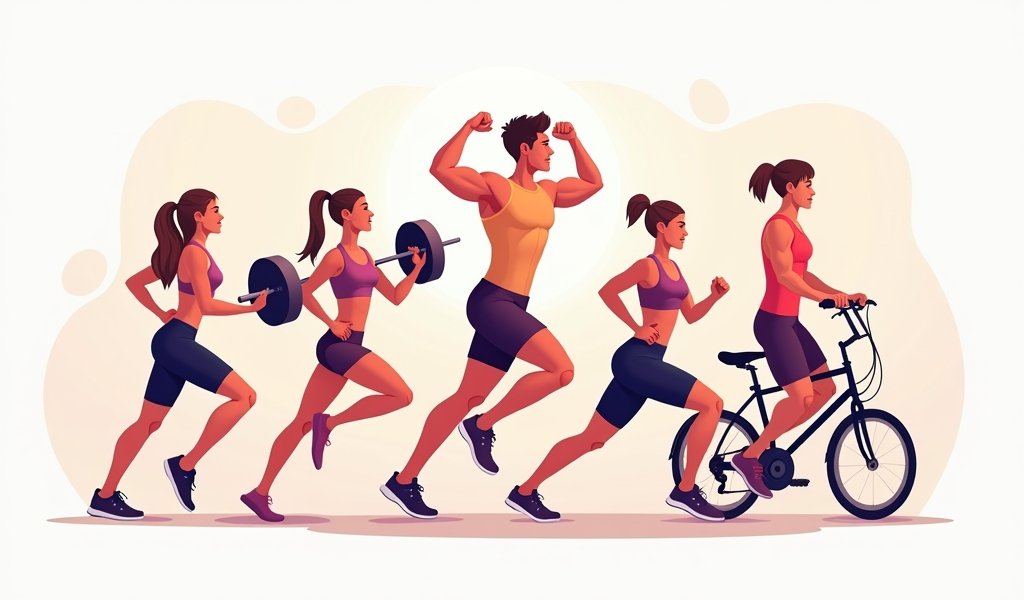
Strength Training: Building a Foundation for Success
Strength training forms the cornerstone of any comprehensive fitness program, with benefits extending far beyond building muscle. This fundamental workout methodology enhances bone density, improves metabolic health, and creates the physical resilience needed for daily activities and other forms of exercise.
The optimal strength training plan follows a progressive resistance model with emphasis on compound movements that engage multiple muscle groups simultaneously. Exercises like squats, deadlifts, bench presses, rows, and overhead presses deliver maximum return on your exercise investment by triggering significant hormonal responses that benefit the entire body.
For beginners, I recommend starting with 2-3 strength sessions weekly, focusing on full-body workouts with 8-10 exercises performed for 2-3 sets of 10-12 repetitions. Intermediate trainees can progress to split routines (upper/lower or push/pull/legs) allowing for increased volume and intensity while maintaining adequate recovery periods.
Rest intervals between sets should typically range from 60-90 seconds for general fitness goals, while those pursuing maximum strength gains may benefit from extended 2-3 minute recovery periods. Proper technique always takes precedence over the amount of weight lifted—a principle that research from the American College of Sports Medicine consistently reinforces.
Sample Strength Training Split
- Monday: Full-body strength focus
- Wednesday: Upper body emphasis
- Friday: Lower body and core emphasis
For optimal results, progression should be strategic and planned. Increase weight by approximately 5-10% once you can complete all prescribed sets and repetitions with proper form. This methodical approach creates sustainable progress while minimizing injury risk.
High-Intensity Interval Training (HIIT): Maximum Results in Minimum Time
High-Intensity Interval Training has revolutionized the fitness landscape by delivering remarkable cardiovascular and metabolic benefits in significantly less time than traditional steady-state cardio. This time-efficient approach alternates between periods of near-maximal effort and strategic recovery intervals.
The scientific principle behind HIIT’s effectiveness lies in its ability to trigger excess post-exercise oxygen consumption (EPOC), commonly known as the “afterburn effect.” This physiological response means your body continues burning calories at an elevated rate for up to 24-48 hours after completing your workout.
An effective HIIT protocol might involve 20-30 seconds of all-out effort followed by 40-60 seconds of active recovery, repeated for 15-25 minutes. This formula can be applied to various modalities including sprinting, cycling, rowing, bodyweight exercises, or resistance training circuits.
Research from the Harvard Medical School indicates that HIIT produces similar or superior cardiovascular adaptations compared to moderate-intensity continuous training, despite requiring less than half the time commitment. For busy professionals, this efficiency makes regular exercise considerably more accessible.
However, proper execution requires attention to intensity—your work intervals must truly approach maximum effort for optimal results. Additionally, due to HIIT’s demanding nature, most individuals should limit sessions to 2-3 times weekly, allowing 48 hours between sessions for adequate recovery.
Functional Fitness: Practical Movement for Everyday Life
Functional fitness focuses on training movements rather than isolated muscles, preparing your body for the multidirectional challenges of daily living. Unlike conventional gym exercises that often occur in a single plane of motion, functional training emphasizes compound, multi-joint patterns that replicate real-world activities.
This approach bridges the gap between exercise and practical application, enhancing your ability to perform everyday tasks with greater ease and reduced injury risk. Core stability, balance, coordination, and proprioception receive special emphasis within functional training protocols.
A comprehensive functional fitness plan incorporates movement patterns including pushing, pulling, squatting, lunging, rotating, carrying, and gait training. Equipment such as kettlebells, suspension trainers, medicine balls, and stability tools create varied challenges that prevent adaptation plateaus.
For optimal results, functional exercises should progress through three stages: mastering basic movement patterns, adding resistance or instability elements, and finally incorporating dynamic, multi-planar sequences. This progressive approach ensures proper skill development before increasing complexity.
According to research published in the International Journal of Environmental Research and Public Health, functional training produces superior improvements in balance, coordination, and performance in activities of daily living compared to traditional resistance training, particularly for aging populations.

Cardiovascular Conditioning: Heart Health and Endurance
Despite the rising popularity of high-intensity workouts, traditional cardiovascular training remains essential for comprehensive health. Regular aerobic exercise strengthens your heart, improves lung capacity, enhances circulation, and builds the endurance foundation necessary for all other physical activities.
The mental health icon of modern fitness programming recognizes that cardiovascular exercise significantly impacts brain health through increased blood flow, enhanced neurotransmitter production, and improved stress management capacity.
For optimal cardiovascular development, a balanced approach incorporating both steady-state and varied-intensity training yields superior results. Steady-state sessions (maintaining 60-70% of maximum heart rate for 30-60 minutes) build aerobic efficiency and fat utilization, while interval-based sessions improve lactate threshold and VO2 max.
The frequency recommendation follows a polarized training model: 2-3 longer, lower-intensity sessions combined with 1-2 higher-intensity workouts weekly, allowing sufficient recovery between challenging efforts. This approach mirrors the training methodology utilized by elite endurance athletes while remaining accessible to general fitness enthusiasts.
Modality variation plays an important role in sustainable cardiovascular programming. Rotating between activities like walking, jogging, cycling, swimming, and rowing reduces repetitive stress while engaging different muscle groups and movement patterns. The Mayo Clinic’s guidelines support this cross-training approach for optimal cardiorespiratory development.
Flexibility and Mobility Training: The Missing Component
Flexibility and mobility work often remains the most neglected aspect of fitness programming, yet it serves as the foundation for all other physical capabilities. While flexibility refers to a muscle’s ability to lengthen, mobility encompasses the functional range of motion within a joint—both elements require dedicated attention.
The benefits extend far beyond simply feeling limber. Proper mobility reduces injury risk, improves movement efficiency, enhances recovery, and allows for optimal technique in strength and cardiovascular activities. In essence, it enables your body to fully express its physical potential.
An effective flexibility protocol should include both static stretching (holding positions for 30-60 seconds) and dynamic mobility work (controlled movements through progressively increasing ranges). For optimal results, static stretching works best after workouts when tissues are warm, while dynamic mobility serves as excellent preparation before exercise.
Key areas requiring focused attention include the hip complex, thoracic spine, shoulders, and ankle joints—regions where modern lifestyle factors often create significant restrictions. Implementing daily mobility “snacks” of 5-10 minutes provides better outcomes than occasional longer sessions.
According to research published in the Journal of Strength and Conditioning Research, combining dynamic mobility work with targeted static stretching produces superior improvements in functional range of motion compared to either method used exclusively.
Mind-Body Connection: Yoga and Pilates Approaches
Mind-body disciplines represent a crucial dimension of comprehensive fitness programming, offering unique benefits that extend beyond physical adaptations. These methodologies emphasize the integration of breath control, mindful movement, and precise body awareness—elements often underemphasized in conventional training approaches.
Yoga practices combine flexibility development with isometric strength challenges while promoting parasympathetic nervous system activation. This combination supports recovery, stress management, and improved body awareness. Styles range from restorative approaches focusing on relaxation to more physically demanding practices like vinyasa or power yoga.
Pilates methodology centers on core stabilization, neutral spine maintenance, and precise movement control. Its principles of centering, concentration, control, precision, flow, and breath translate remarkably well to improving performance in all other physical activities by establishing fundamental movement competency.
Recent men’s mental health awareness initiatives have highlighted how these practices can be particularly beneficial for populations traditionally less likely to address stress management and recovery aspects of wellness. The mind-body connection fostered through these practices offers significant psychological benefits alongside physical improvements.
For optimal integration, incorporate 1-2 weekly sessions of either yoga or Pilates as complementary training to more conventional workout methods. This balanced approach addresses both physical intensity and restorative needs, creating sustainable progression without overtraining risks.
The Comprehensive Beginner Plan: Starting Your Fitness Journey
Beginning a fitness journey requires a thoughtful approach that builds confidence, establishes proper movement patterns, and creates sustainable habits. The initial weeks should prioritize technique development and consistency over intensity or volume—laying a foundation for long-term success.
An ideal starter program incorporates elements from each of the workout methodologies discussed, but with appropriate modifications for beginner-level capacity. This balanced approach prevents overspecialization while developing fundamental fitness attributes.
For beginners, I recommend the following weekly structure:
- Monday: Full-body strength training (basic compound movements, focus on form)
- Tuesday: Low-impact cardiovascular activity (20-30 minutes at conversational intensity)
- Wednesday: Active recovery (walking, light mobility work)
- Thursday: Beginner-friendly yoga or fundamental movement patterns
- Friday: Full-body strength training (progression from Monday)
- Saturday: Longer cardiovascular session or nature-based activity
- Sunday: Complete rest or gentle mobility work
This framework establishes a sustainable rhythm while introducing varied training stimuli. Most importantly, it acknowledges that recovery and progression rates differ substantially between individuals—what matters most is consistent implementation over time.
According to research from the American Council on Exercise, beginners who follow structured programs with gradual progression demonstrate 65% higher adherence rates after six months compared to those attempting more aggressive approaches.
Implementing These Plans Into Your Lifestyle
Understanding effective workout methodologies represents only half the equation—successful implementation requires strategic integration into your existing lifestyle. The most physiologically sound program delivers no benefit if adherence proves impossible within your current life constraints.
Begin by conducting an honest assessment of your schedule, identifying realistic time blocks for exercise. Research consistently demonstrates that morning workouts correlate with higher adherence rates, but the optimal timing ultimately remains when you can consistently execute your plan.
Preparation significantly impacts consistency. Establish systems that minimize friction points: prepare workout clothes in advance, schedule sessions in your calendar with the same commitment as professional appointments, and create environmental cues that support your fitness intentions.
The concept of habit stacking—attaching new behaviors to existing habits—can dramatically improve adherence. For example, performing a brief mobility routine immediately after brushing your teeth leverages an established daily pattern to incorporate new behaviors.
Finally, remember that consistency trumps perfection. A sustainable approach that allows for life’s inevitable disruptions will produce superior long-term results compared to an “all-or-nothing” mentality. The ability to return to your routine after interruptions ultimately determines your success trajectory.
Conclusion
The seven proven workout plans explored in this Essential Health and Fitness Review represent complementary approaches that, when strategically implemented, create a comprehensive framework for physical development and wellbeing. From the foundational strength training that enhances metabolism and functional capacity to the mind-body practices that promote recovery and stress management, each methodology addresses critical aspects of physical wellness.
The key to success lies not in dogmatically following a single approach but in understanding how these various training modalities complement one another. By incorporating elements from strength training, HIIT, functional fitness, cardiovascular conditioning, flexibility work, and mind-body practices into a cohesive program, you create a balanced approach that promotes sustainable progress.
Remember that fitness represents a lifelong journey rather than a destination. As your capacity develops, your programming should evolve accordingly, embracing new challenges while maintaining foundational principles. The framework outlined here provides not just immediate guidance but a roadmap for continued development across your fitness lifespan.
Implementation ultimately determines results. Start where you are, focus on consistency rather than perfection, and trust the cumulative effect of regular, purposeful movement. Your future self will thank you for the investment you make today in establishing these essential health and fitness practices.
Frequently Asked Questions
How many days per week should I exercise for optimal results?
Most research suggests 3-5 exercise sessions weekly provides optimal results for general fitness goals. The specific frequency depends on workout intensity, recovery capacity, and your overall lifestyle demands.
Should beginners start with all seven workout types immediately?
No, beginners should start with 2-3 weekly sessions focusing on fundamental movement patterns and gradually increase variety. Mastering basics before adding complexity reduces injury risk and builds sustainable habits.
How long should I follow a workout plan before changing it?
Most effective programs should be followed for 6-12 weeks before significant modifications. This timeframe allows sufficient adaptation while preventing plateaus that occur with excessive routine repetition.
Is it necessary to include all seven workout types in my routine?
While incorporating elements from each category provides comprehensive benefits, your specific goals and time availability may necessitate prioritization. Focus on strength training, cardiovascular work, and mobility as core components for general fitness.
How do I know if I’m making progress with my workout plan?
Track multiple metrics beyond weight, including strength improvements, endurance capacity, recovery rate, energy levels, and movement quality. Comprehensive assessment provides more accurate progress feedback than any single measurement.