

Overview
Forget boring gym routines—this article reveals how Tacoma’s unique geography creates a natural fitness playground, from waterfront workouts that feel like moving meditation to embracing the infamous “liquid sunshine” rather than hiding from it. The guide offers ten location-specific strategies for making exercise sustainable by connecting it to Tacoma’s natural features, community resources, and local food systems, showing how the city’s hills, rain, and even Mount Rainier can transform fitness from a chore into a celebration of place.
Table of Contents
- Tacoma Lifestyle Fitness: Your Path to Lasting Health
- Waterfront Workouts: Harnessing Tacoma’s Natural Gym
- Rain-Ready Fitness: Embracing the Pacific Northwest Weather
- Hill Training: Tacoma’s Natural Resistance Program
- Community Connections: Finding Your Fitness Tribe
- Local Nutrition: Fueling with Tacoma’s Finest
- Metro Parks Fitness: Free Resources at Your Fingertips
- Active Commuting: Transforming Daily Travel into Exercise
- Mountain Inspiration: Leveraging Our Iconic Landmark
- Wellness Resources: Beyond Traditional Exercise
- Work-Life Balance: Fitting Fitness into Tacoma’s Economy
- Conclusion: Your Tacoma Wellness Journey
- Frequently Asked Questions
Tacoma Lifestyle Fitness: Your Path to Lasting Health
Nestled between Mount Rainier and Puget Sound, Tacoma offers a unique backdrop for fitness that goes beyond traditional gym routines. The meaning of fitness takes on new dimensions in our City of Destiny, where natural landscapes provide exceptional opportunities for physical activity and wellness.
As a health professional who’s worked with hundreds of Tacoma residents, I’ve seen firsthand how our city’s distinctive geography, weather patterns, and community resources create opportunities for health optimization you simply won’t find elsewhere. The gentle hills, periodic rainfall, and breathtaking views aren’t obstacles—they’re assets in your fitness journey.
These ten tacoma lifestyle fitness hacks aren’t just theory; they’re proven strategies that locals have used to achieve lasting health while celebrating our unique South Sound environment. Let’s explore how you can transform your fitness routine from a chore into a celebration of place and community.
Waterfront Workouts: Harnessing Tacoma’s Natural Gym
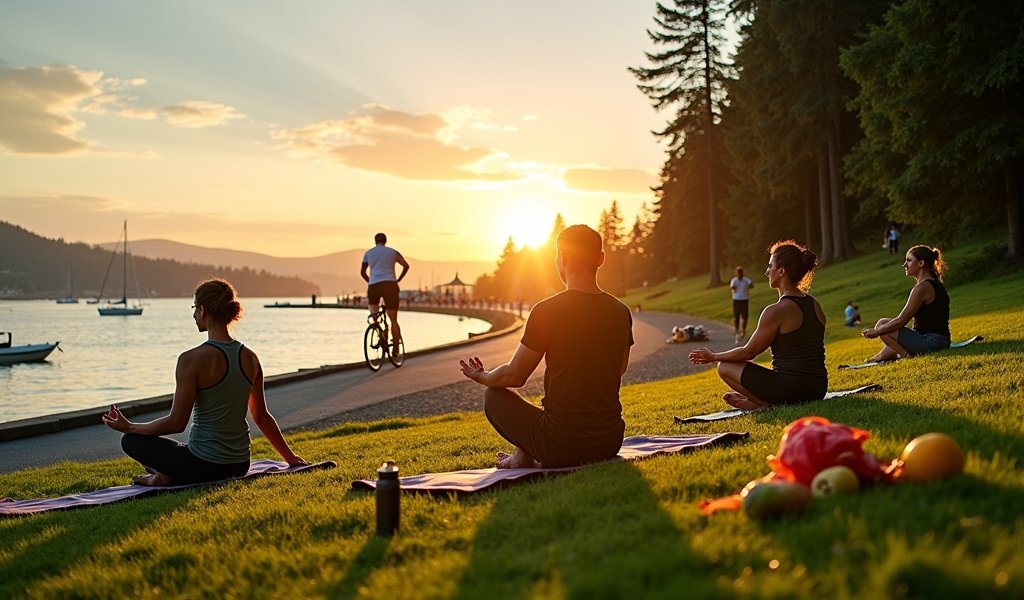
Tacoma’s five-mile waterfront along Ruston Way isn’t just scenic—it’s a comprehensive fitness center without walls. Research from the Journal of Environmental Psychology confirms that exercising near water reduces stress hormones while boosting mental wellbeing, essentially giving your workout a natural psychological advantage.
Here’s a simple waterfront interval training routine my clients love:
- Begin at Chinese Reconciliation Park
- Jog to each pier along the way
- Perform 15 bodyweight squats at each stop
- Use the concrete steps near Old Town Dock for plyometric training
- Finish at Point Ruston for a reward (perhaps a healthy smoothie!)
This natural interval training provides a comprehensive lower body workout while delivering some of the best views in Pierce County. The varying terrain naturally introduces intensity changes, and the sea air adds a refreshing element no indoor gym can match.
Many of my patients report that their waterfront workouts feel less like exercise and more like an experience, making consistency much easier to maintain. The gentle sound of waves creates a meditative backdrop, turning physical activity into moving meditation.
Rain-Ready Fitness: Embracing the Pacific Northwest Weather
In Tacoma, waiting for perfect weather would mean staying indoors for months. Instead, successful locals develop what I call “rain-or-shine” fitness routines that embrace our famous liquid sunshine rather than viewing it as an obstacle.
My recommended rain-adaptive circuit includes:
- Start with covered exercises at Wright Park’s pavilion
- Utilize tree-lined paths for natural rain protection during cardio bursts
- Explore UW Tacoma’s covered walkways for lunges and stair climbs
- Finish with stretching under the Museum of Glass canopy
The key to year-round outdoor fitness in Tacoma is proper gear. Invest in a good waterproof running jacket, moisture-wicking layers, and trail shoes with excellent traction. As we say in healthcare, there’s no such thing as bad weather—just inappropriate clothing choices.
Interestingly, exercising in light rain can actually improve your performance. Studies show the cooling effect can prevent overheating, and the psychological challenge builds mental toughness that transfers to other areas of life. Embrace the rain, and you’ll develop a resilience that fair-weather exercisers never discover.
Hill Training: Tacoma’s Natural Resistance Program
Tacoma quietly offers some of the most challenging urban elevations in the Northwest. These natural features aren’t fitness obstacles—they’re free strength-training equipment embedded into our daily landscape.
For maximum cardiovascular and lower body benefits, try this “Tacoma Tower Climb”:
- Warm up with a light jog to the Stadium District stairs
- Complete 10 repetitions up and down the historic stairways
- Take recovery walks between sets to admire the architecture
- Cool down with a gentle descent back toward Commencement Bay
For cyclists, the North End hills provide what one of my patients humorously calls “involuntary HIIT training.” A route from Point Defiance through Proctor and back delivers about 500 feet of elevation gain over relatively short distances—nature’s way of saying leg day isn’t optional in Tacoma.
The beauty of Tacoma’s topography is that you can easily adjust intensity based on your fitness level. Beginners might start with the gentle inclines around Wright Park, while more advanced fitness enthusiasts can challenge themselves with the steep climbs near Stadium High School. Your body will thank you with increased bone density, improved cardiovascular capacity, and stronger lower body muscles.
Community Connections: Finding Your Fitness Tribe
Tacoma’s fitness centers aren’t just places to lift weights—they’re community hubs with distinct personalities reflecting our city’s diverse neighborhoods. Research consistently shows that social connection is one of the strongest predictors of exercise adherence, and our local fitness scene excels at fostering these bonds.
Facilities like the Morgan Family YMCA don’t just offer equipment—they provide Tacoma-specific programming like Mount Rainier preparation classes and pre-Seafair training programs. Many local gyms organize weekend meetups at Point Defiance or Chambers Bay, combining conventional training with Tacoma’s natural features.
For seniors looking for age-appropriate options, there are excellent exercise classes for seniors near you that combine fitness with social engagement. These programs understand the unique needs of older adults while fostering important community connections.
The accountability factor of these community connections is powerful—knowing your absence will be noticed at Tuesday’s boot camp provides motivation that solo workouts rarely generate. As one of my patients recently shared, “My Tacoma running group got me through the darkest, rainiest winter I can remember. Without them waiting for me each Saturday, I would have stayed in bed.”
Local Nutrition: Fueling with Tacoma’s Finest

Fitness happens in the gym, but health is built in the kitchen—preferably with ingredients sourced from our local producers. The Broadway Farmers Market (Thursdays) and Proctor Farmers Market (Saturdays) offer seasonal produce picked at peak nutrition, often harvested just hours before reaching your table.
Here’s why local nutrition matters for your fitness goals:
- Fresher produce means higher nutrient content
- Seasonal eating naturally varies your diet throughout the year
- Local food requires less preservation, reducing additives
- Supporting local farms improves our food security long-term
Make market shopping part of your weekly fitness routine—walking the market circuit while carrying increasingly heavy bags of farm-fresh produce is essentially a functional workout disguised as errands. The seasonal rotation of available foods naturally helps Tacoma residents eat according to what our bodies need throughout the year.
According to Harvard’s Nutrition Source, locally-sourced food not only supports environmental sustainability but often encourages healthier eating patterns. When you connect with local farmers and understand how your food is grown, you develop a deeper appreciation for nutrition that translates into better choices.
Metro Parks Fitness: Free Resources at Your Fingertips
One of Tacoma’s best-kept fitness secrets hides in plain sight: our Metro Parks system offers an impressive array of free and low-cost fitness programming throughout the year. While visitors might see our parks as just pretty green spaces, locals know they’re comprehensive outdoor gyms with structured activities for every fitness level.
Take advantage of these exceptional resources:
- Free “Fitness in the Parks” summer classes (yoga, Zumba, boot camps)
- Fitness stations along Ruston Way for resistance training
- Wellness walks led by trained fitness professionals
- Designated trails with measured distances for tracking progress
Even the park features themselves are designed with fitness in mind. The distance markers at Point Defiance’s Five Mile Drive help with interval training, while the varying terrain naturally challenges different muscle groups. For families, park playgrounds provide opportunities for adults to exercise alongside playing children—try alternating between playground-based exercises while supervising kids.
As a healthcare provider, I often prescribe specific park activities as part of treatment plans. The combination of fresh air, natural surroundings, and physical activity creates a therapeutic environment that enhances the benefits of exercise. Your tax dollars already pay for these resources—using them is simply claiming what’s already yours.
Active Commuting: Transforming Daily Travel into Exercise
Transform your daily commute from sedentary drive time to active journey with Tacoma’s increasingly connected transportation infrastructure. The city’s investment in the Prairie Line Trail, Pipeline Trail, and other connecting pathways makes active commuting more feasible than ever.
Active commuting brings multiple benefits:
- Built-in daily exercise that doesn’t require extra time
- Reduced transportation costs (gas, parking, vehicle maintenance)
- Lower environmental impact
- Improved mental health from starting/ending your day actively
For bicycle commuters, the route from the North End to downtown offers both convenience and a decent workout. Many local employers now offer secure bike storage and shower facilities—a growing recognition that active commuting benefits both employees and companies through improved health and reduced absenteeism.
Even public transportation can be incorporated into active lifestyles. Try what I call the “transit plus” approach: get off the bus several stops early and walk the remainder of your route. This adds steps to your day while maintaining the convenience of motorized transport for part of your journey.
According to research published in the British Medical Journal, active commuters show significantly lower rates of cardiovascular disease and obesity. Just 15-30 minutes of active commuting each way may be enough to meet most adults’ daily exercise requirements.
Mountain Inspiration: Leveraging Our Iconic Landmark
The Mountain—as locals reverentially call Rainier—isn’t just a postcard backdrop. It’s Tacoma’s natural fitness inspiration standing majestically on our horizon. Weekend adventures at Mount Rainier National Park provide both physical challenges and mental restoration that carry benefits well beyond the time spent on the trails.
Use Tacoma’s urban environment to train for mountain adventures:
- The steep paths at Point Defiance simulate mountain trail conditions
- Stadium stairs help develop hiking-specific muscles needed for elevation gain
- Local hiking groups organize progressive “training hikes” of increasing difficulty
- Urban hill routes can be used to prepare for mountain elevation changes
Even for those who never plan to climb to Camp Muir, the psychological benefit of having wilderness access within a 90-minute drive provides what psychologists call “nature restoration therapy”—a valuable counterbalance to urban living that reduces stress and improves cognitive function.
Many of my patients set mountain-related goals as motivation—whether it’s hiking to a specific waterfall by summer or simply improving their stamina enough to enjoy longer forest walks. Having The Mountain as a visual reminder of these goals provides daily inspiration that abstract fitness targets simply can’t match.
Wellness Resources: Beyond Traditional Exercise
Beyond traditional fitness, Tacoma offers a rich tapestry of wellness resources that support holistic health approaches. Local practitioners understand the unique stressors and lifestyle factors that affect South Sound residents, from seasonal light changes to the particular demands of our major employers.
Explore these complementary wellness resources:
- Specialized massage therapy addressing issues from hill running
- Acupuncture targeted at recovery enhancement
- Vitamin D therapy designed for our gray winters
- Stress management workshops specific to Pacific Northwest living
Many wellness centers offer sliding scale or community clinic days, making these complementary health approaches more accessible. The holistic homemaking approach to health recognizes that fitness extends beyond exercise into how we create and maintain our living environments.
Community workshops frequently focus on Tacoma-specific wellness challenges, like maintaining energy levels during our gray winters or managing seasonal affective disorder through movement. These locally-tailored approaches often prove more effective than generic wellness advice found online.
Remember that true fitness encompasses physical, mental, and emotional wellbeing. Tacoma’s wellness community excels at addressing this full spectrum, helping residents develop resilience in all aspects of health.
Work-Life Balance: Fitting Fitness into Tacoma’s Economy
Tacoma’s evolving economy—with its mix of healthcare, education, manufacturing, and growing tech presence—creates both challenges and opportunities for fitness integration. Understanding how to navigate these specific work environments can make consistent exercise more achievable.
Strategies for different work situations include:
- Healthcare workers: Utilize 24-hour facilities that accommodate shift work
- Port and industrial workers: Focus on countering occupational movements
- Office professionals: Implement standing desks and walking meetings
- Remote workers: Schedule mid-day outdoor breaks to combat sedentary patterns
Major employers like MultiCare and CHI Franciscan offer employee wellness programs with discounts to local fitness facilities, while tech companies downtown increasingly provide active workplace initiatives as standard practice. Even the Port of Tacoma has implemented movement programs for industrial workers, recognizing that physical activity benefits productivity and reduces workplace injuries.
As reported by the CDC’s Workplace Health Program, employees who participate in workplace wellness initiatives show lower healthcare costs and fewer sick days. By taking advantage of employer-sponsored fitness programs, you’re essentially getting paid to improve your health.
Conclusion: Your Tacoma Wellness Journey
These ten Tacoma lifestyle fitness hacks aren’t meant to be implemented in isolation—they work together to create a comprehensive approach to health that honors our unique geographic and cultural landscape. By connecting with our waterfront, embracing our hills, building community through local fitness resources, and fueling with regional foods, you can develop sustainable health practices that feel less like a generic fitness plan and more like a natural expression of place.
The beauty of the Tacoma approach to fitness is that it’s accessible regardless of your starting point. Whether you’re a longtime resident looking to refresh your routine or a newcomer wanting to connect with our community through movement, these strategies provide practical entry points for lasting health.
Start with just one or two of these locally-tailored approaches. Notice how much more sustainable your fitness routine becomes when it’s connected to the place you call home. Your body—and your community—will thank you.
Remember that fitness isn’t a destination but a journey—one that’s much more enjoyable when it celebrates the natural beauty, community resources, and unique character of our City of Destiny.
Frequently Asked Questions
What makes the Tacoma lifestyle unique for fitness?
Tacoma offers a distinctive combination of waterfront paths, urban hills, accessible parks, and mountain proximity that creates natural fitness opportunities. The city’s weather patterns and topography provide year-round training variables that keep workouts fresh and challenging.
How can I stay active in Tacoma during rainy weather?
Invest in quality waterproof gear, utilize covered areas like Wright Park’s pavilion, and embrace the rain as part of your training environment. Many locals develop “rain-or-shine” circuits that incorporate covered locations for more intense exercises.
Where can I find free fitness resources in Tacoma?
Metro Parks Tacoma offers free “Fitness in the Parks” programs throughout summer, plus year-round access to trails, fitness stations, and recreational facilities. Many community centers also provide free or low-cost fitness classes for residents.
How do I connect with fitness groups in Tacoma?
Local running stores, community centers, and fitness facilities often host group workouts welcoming newcomers. Social media platforms like Facebook and Meetup feature numerous Tacoma-specific fitness groups organized by activity type and experience level.
What’s the best way to incorporate Mount Rainier into my fitness routine?
Use urban training like hill work and stair climbing to prepare for mountain adventures on weekends. Many local hiking groups offer progressive “training series” that build skills and endurance for more challenging mountain activities.