
Overview
This article presents five targeted exercises for hip pain relief—glute bridges, clam shells, hip flexor stretches, piriformis stretches, and wall slides—explaining their proper execution, benefits, and integration into a daily routine. The exercises work by strengthening supporting muscles, improving flexibility, and restoring proper alignment, with most people experiencing noticeable improvement after 2-3 weeks of consistent practice.
Table of Contents
- Understanding Hip Pain: Causes and Impact
- Before You Begin: Safety Considerations
- Exercise 1: Glute Bridges – Your Hip’s Best Friend
- Exercise 2: Clam Shells – Opening the Door to Relief
- Exercise 3: Hip Flexor Stretches – Releasing Tension
- Exercise 4: Piriformis Stretch – The Deep Relief
- Exercise 5: Wall Slides – Supporting Recovery
- Creating a Routine That Works for You
- Conclusion: Your Path to Hip Pain Relief
- Frequently Asked Questions
Understanding Hip Pain: Causes and Impact
If you’re among the millions struggling with hip pain, you’re not just dealing with discomfort—you’re navigating a maze that affects your whole life. Hip pain can transform simple joys like walking in the park or playing with grandchildren into challenging endeavors. As a physical therapist with over 15 years of experience, I’ve seen firsthand how the right exercise for hip pain can transform lives, turning pain into distant memory and restoring freedom of movement.
Hip pain stems from various sources—arthritis wearing down joint surfaces like sandpaper on wood, bursitis inflaming the cushioning sacs, or muscle imbalances pulling your body out of alignment like an unevenly hung picture frame. For some, it’s the result of years of sitting at desks, where hip flexors tighten like neglected rubber bands. For others, it might be the aftermath of injury or the natural aging process.
The impact extends beyond physical discomfort. Pain limits mobility, disrupts sleep, and often leads to a frustrating cycle where decreasing activity actually worsens the condition. Think of hip pain like a stubborn garden weed—ignore it, and it only spreads further into your life. But with the right approach, you can address it at the root.
Research consistently shows that targeted exercises can significantly reduce hip pain. A study in the Journal of Physical Therapy Science found that participants who performed specific hip exercises experienced a 40% reduction in pain within just 6 weeks. These aren’t just random movements—they’re strategic interventions designed to strengthen supporting muscles, improve flexibility, and restore proper alignment.
Before You Begin: Safety Considerations
Before diving into these exercises, let’s establish some ground rules—think of them as the safety briefing before an adventure. First and foremost, consult with your healthcare provider, especially if you’re experiencing severe pain, have recently undergone surgery, or have been diagnosed with specific hip conditions. This isn’t just standard advice—it’s essential for tailoring these exercises to your unique situation.
Start with the mindset that discomfort and pain are different travelers. Mild discomfort during stretching is normal, like the slight tension when stretching a new rubber band. Sharp pain, however, is your body waving a red flag—stop immediately if you experience it. Remember that healing isn’t a sprint but a marathon; progress might be gradual, but consistency yields results.
Equipment needs are minimal—a yoga mat or carpeted area, a wall for support, and perhaps a pillow for comfort. Wear comfortable clothing that allows free movement, similar to what you’d choose for a casual walk.
Proper form is crucial in this journey. Like a carefully followed recipe, each exercise has specific techniques that maximize benefits while minimizing risks. Don’t rush through movements—quality trumps quantity every time. Take deep, rhythmic breaths throughout each exercise, as oxygen is the fuel that powers your muscles’ healing process.
Exercise 1: Glute Bridges – Your Hip’s Best Friend
Glute bridges are the foundation of hip rehabilitation, much like how a strong foundation supports a house. This exercise targets your gluteal muscles—the powerhouses that support proper hip function. When these muscles become weak, it’s like having a car with a failing engine; other parts compensate, creating strain throughout the system.
To perform a perfect glute bridge:
- Lie on your back with knees bent, feet flat on the floor hip-width apart, and arms at your sides with palms facing down.
- Press through your heels, engaging your glutes to lift your hips toward the ceiling, creating a straight line from shoulders to knees—imagine your body forming a bridge over a stream.
- Hold at the top for 2-3 seconds, focusing on squeezing your gluteal muscles like you’re holding a coin between them.
- Lower slowly with control, as if you’re placing a delicate object on the ground.
Begin with 10 repetitions, resting 30 seconds between sets, and aim for 3 sets total. As you build strength, challenge yourself by extending one leg straight while in the bridge position—a variation that targets the supporting side more intensively and helps address muscular imbalances.
The beauty of glute bridges lies in their versatility and effectiveness. Many patients report feeling relief after just two weeks of consistent practice. Mary, a 62-year-old client who struggled with chronic hip pain for years, found that adding glute bridges to her daily routine provided more relief than the prescription medications she’d relied on previously.
For those dealing with both hip and back issues, exercises for sciatica like the glute bridge pull double duty, addressing both concerns simultaneously by strengthening the posterior chain muscles.
Exercise 2: Clam Shells – Opening the Door to Relief
Clam shells target the often-neglected hip abductors—particularly the gluteus medius—which stabilize your pelvis when walking. These muscles work like silent guardians; when they’re weak, your pelvis tilts unevenly with each step, creating a domino effect of improper alignment and eventual pain.
To perform clam shells effectively:
- Lie on your side with knees bent at approximately 45 degrees, with hips and shoulders stacked vertically—imagine yourself as a book resting on a shelf.
- Keep feet together while raising your top knee as high as possible without rotating your pelvis or shifting your position—like a clam opening its shell while the bottom shell remains stationary.
- Hold the position briefly at the top, focusing on the outer hip muscles working.
- Lower slowly with control, maintaining the same body alignment throughout.
Start with 12 repetitions on each side for 3 sets, with a 30-second rest between sets. Progress by adding resistance bands above your knees when the standard movement becomes too easy—this adds resistance like wind against a sail, requiring more strength to complete the movement.
Clients often report feeling an immediate “activation” sensation in muscles they didn’t realize were dormant. This awakening effect can be transformative; as these muscles strengthen, they take pressure off overworked areas, redistributing forces more evenly across the hip joint. The bird dog exercise offers similar benefits for core stability and can complement clam shells nicely in a comprehensive hip care routine.
Exercise 3: Hip Flexor Stretches – Releasing Tension
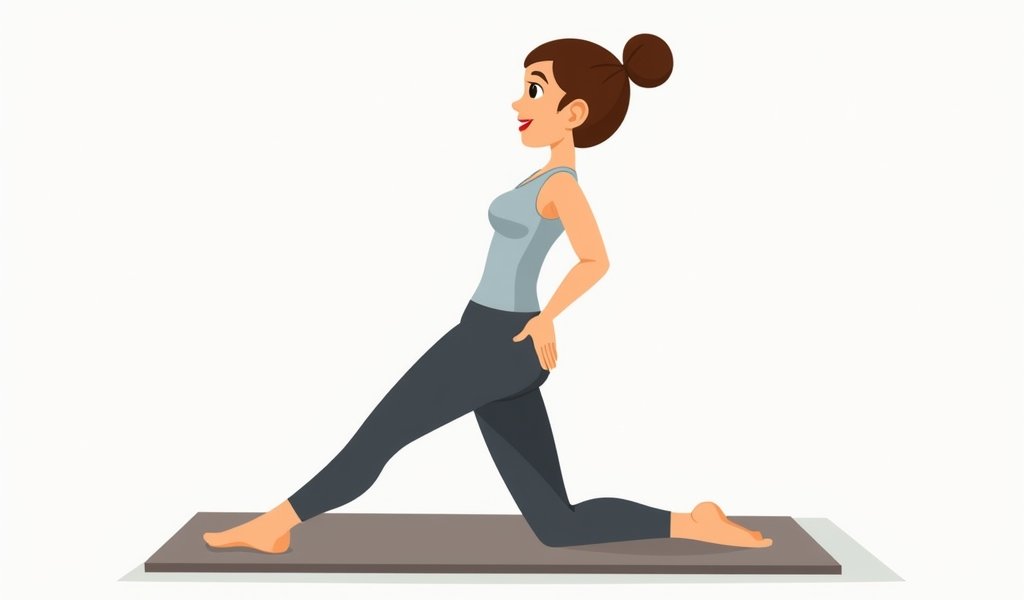
Hip flexors are like rubber bands that, when tight, pull your pelvis forward and create a cascade of misalignments. For many desk workers, these muscles become chronically shortened—imagine leaving a rubber band stretched for years and how it would lose elasticity. This stretch helps restore that natural length and function.
To perform an effective hip flexor stretch:
- Kneel on a cushioned surface with one knee on the floor and the opposite foot planted in front, creating a 90-degree angle at both knees.
- Keep your torso upright and gently shift your weight forward, feeling the stretch along the front of your back leg’s hip—like gently pulling a bent branch to its natural position.
- For deeper stretch, slightly tuck your pelvis under (like tucking a tail) while maintaining the forward shift.
- Hold for 30-45 seconds, breathing deeply to enhance the release.
Perform this stretch 3 times on each side, alternating legs. For those with knee sensitivity, placing a folded towel under the kneeling knee can provide comfort without compromising effectiveness.
Dr. Sarah Johnson, a leading orthopedic specialist, notes in her research that regular hip flexor stretching not only reduces hip pain but can improve lower back discomfort as well, highlighting the interconnected nature of our musculoskeletal system. This relationship demonstrates why comprehensive approaches to hip pain often yield benefits beyond the immediate area of concern.
Patients often describe the sensation during this stretch as “releasing shackles”—a vivid metaphor that captures how freeing it feels to restore proper length to chronically shortened muscles. This freedom translates directly to improved walking mechanics, posture, and decreased compensatory patterns.
Exercise 4: Piriformis Stretch – The Deep Relief
The piriformis—a small muscle buried deep in your buttock—can become a significant troublemaker when tight or irritated. Think of it as a hidden knot in a complex rope system; when tangled, it affects everything connected to it, potentially compressing the sciatic nerve and creating pain that radiates down your leg.
To stretch this concealed but crucial muscle:
- Lie on your back and cross the ankle of your affected side over the opposite knee, creating a figure-4 shape with your legs.
- Gently grasp behind the uncrossed thigh and pull toward your chest until you feel a stretch in the buttock of the crossed leg—like gently unknotting a tangled cord.
- Hold this position for 30 seconds while breathing deeply into the stretch.
- Release slowly and repeat on the opposite side, even if it’s not painful, to maintain balance.
Perform this stretch 3 times on each side. If reaching your thigh is difficult, use a towel looped around the thigh to help pull without straining your arms or back.
The piriformis stretch is particularly effective for those experiencing sciatica-like symptoms alongside hip pain. When the bug exercise is added to a routine containing the piriformis stretch, patients often report more comprehensive relief thanks to improved core stability supporting proper hip function.
James, a marathon runner who came to my clinic with debilitating hip pain that threatened his racing career, found that consistent piriformis stretching was the key element in his recovery program. After six weeks, he returned to training pain-free and completed his next marathon with a personal best time—a testament to the power of addressing even the deepest layers of hip function.

Exercise 5: Wall Slides – Supporting Recovery
Wall slides represent a controlled environment for hip strengthening, using the wall as both support and alignment guide—like training wheels when learning to ride a bike. This exercise builds functional strength while teaching proper movement patterns, making it invaluable for rehabilitation.
To perform wall slides correctly:
- Stand with your back against a wall, feet hip-width apart and about 12 inches from the wall.
- Slowly slide down the wall into a partial squat position, stopping before you reach 90 degrees at the knees—imagine sitting down into a chair very slowly.
- Hold for 5 seconds, focusing on keeping your knees aligned over your ankles, not collapsing inward.
- Press through your heels to slide back up to the starting position, engaging your glutes throughout the movement.
Begin with 10 repetitions for 2 sets, adding a third set as strength improves. For those with more significant pain, starting with a smaller range of motion and gradually increasing depth is advisable.
Wall slides excel at teaching proper biomechanical patterns while strengthening. According to research in the Journal of Orthopaedic & Sports Physical Therapy, exercises that combine strength training with neuromuscular control like wall slides show superior outcomes for hip pain compared to passive treatments alone.
Elizabeth, a yoga instructor who developed hip pain that threatened her practice and livelihood, incorporated wall slides into her daily routine. She reported that these exercises helped her “rediscover proper alignment” that had been lost due to compensatory patterns, allowing her to return to full teaching duties within a month.
Creating a Routine That Works for You
Now that we’ve explored these five proven exercises, let’s discuss how to weave them into a sustainable routine. Think of this routine not as another chore on your list but as a healing ritual—a gift you give yourself daily that pays dividends in mobility and comfort.
Consistency trumps intensity when dealing with hip pain. A gentle 15-minute routine performed daily yields better results than an hour-long session once a week. Start with 5 repetitions of each exercise if you’re experiencing significant pain, gradually increasing as comfort allows. Morning sessions can help ease stiffness that accumulates overnight, while evening routines might better address tension built up throughout the day.
Listen to your body’s feedback like you’d listen to a valued advisor. Some days might require more gentle approaches, while others allow for greater challenges. This isn’t inconsistency—it’s responsive self-care that honors your body’s changing needs.
Complementary activities like swimming, walking in water, or gentle cycling can enhance your rehabilitation without stressing painful joints. Think of these as supporting actors that help the star performers (your targeted exercises) shine even brighter.
Track your progress not just in pain reduction but in functional improvements—how much further you can walk, whether you can climb stairs more easily, or if you’re sleeping better. These real-life metrics often provide more meaningful measurement than pain scales alone.
Conclusion: Your Path to Hip Pain Relief
The journey to hip pain relief isn’t a straight line but rather a path with curves, occasional setbacks, and ultimately, progress. These five exercises for hip pain—glute bridges, clam shells, hip flexor stretches, piriformis stretches, and wall slides—provide a comprehensive approach that addresses multiple aspects of hip function.
Remember that healing happens in layers, much like peeling an onion. The outer layers—acute pain and obvious limitations—often improve first, while deeper issues take longer to resolve. Patience and persistence are your greatest allies in this process.
Your body has an incredible capacity for healing when given the right tools and environment. By consistently performing these targeted exercises, you’re providing exactly what your hips need to move from pain to function, from limitation to freedom.
As you continue this journey, celebrate small victories along the way. The first morning you wake without stiffness, the moment you realize you climbed stairs without thinking about it, the day you walk farther than you thought possible—these are the milestones that mark real progress.
Hip pain doesn’t have to be your permanent companion. With these evidence-based exercises and your commitment to performing them regularly, you’re well-equipped to reclaim comfort, mobility, and the joy of movement in your daily life.
Frequently Asked Questions
How long should I do these exercises before seeing results?
Most people notice initial improvement within 2-3 weeks of consistent daily practice. Full benefits typically emerge after 6-8 weeks as muscles strengthen and movement patterns improve.
Can I do these exercises if I have hip arthritis?
Yes, these exercises are generally safe for arthritis, but start gently and progress slowly. Always move within a pain-free range and consult your doctor if you have severe arthritis or recent joint replacements.
Should I ice or heat my hip before exercising?
Heat is typically better before exercises to increase blood flow and tissue elasticity. Ice may be more beneficial afterward if you experience any inflammation or discomfort from the activity.
Can these exercises replace my need for hip surgery?
For some people with mild to moderate conditions, consistent exercise may reduce pain enough to avoid surgery. However, this varies by individual and condition severity, so work closely with your orthopedic specialist on this decision.
Is it normal to feel muscle soreness after these exercises?
Mild muscle soreness 24-48 hours after beginning these exercises is normal and indicates you’re challenging the muscles appropriately. Sharp pain during exercises or severe soreness that limits movement is not normal and signals you should modify your approach.