

Overview
Like a caffeine shot for your company’s health culture, this article serves up seven innovative corporate wellness solutions—from on-site fitness centers and gym partnerships to virtual programs, gamified challenges, holistic approaches, flexible stipends, and active workplace designs. The piece emphasizes that successful wellness initiatives require strategic implementation with clear goals, leadership buy-in, effective communication, and meaningful measurement to deliver significant returns on investment through healthier, happier, and more productive employees.
Table of Contents
- Introduction
- Understanding Corporate Wellness
- Fitness Solution #1: On-Site Fitness Centers
- Fitness Solution #2: Corporate Fitness Partnerships
- Fitness Solution #3: Virtual Fitness Programs
- Fitness Solution #4: Wellness Challenges and Gamification
- Fitness Solution #5: Holistic Wellness Approaches
- Fitness Solution #6: Flexible Wellness Stipends
- Fitness Solution #7: Active Workplace Design
- Implementation and Measurement
- Conclusion
- Frequently Asked Questions
Introduction
In today’s high-pressure corporate world, where deadlines loom like storm clouds and stress accumulates faster than emails in your inbox, workplace wellness programs have transformed from a nice-to-have perk to an essential business strategy. Like a well-oiled machine requires regular maintenance, the modern workforce needs proper care to perform at its best.
The business case for corporate wellness initiatives has never been stronger. With healthcare costs climbing steeper than a StairMaster workout, companies are feeling the financial strain. According to Willis Towers Watson, employer healthcare costs are projected to increase by 6.5% in 2023 alone, continuing an upward trend that shows no signs of plateauing.
Smart businesses are realizing that investing in prevention is like buying an umbrella before the storm – it simply makes good financial sense. A comprehensive corporate wellness program not only reduces healthcare costs but also boosts productivity, improves morale, and helps attract and retain top talent.
In this guide, we’ll explore seven fitness solutions that can revolutionize your corporate wellness program. From traditional approaches to innovative solutions, I’ll provide you with a roadmap to wellness success based on my experience as a corporate health consultant.
Understanding Corporate Wellness
Corporate wellness programs have evolved dramatically since their inception in the 1970s. What began as simple smoking cessation initiatives have blossomed into comprehensive health promotion strategies that address physical, mental, and emotional wellbeing.
Today’s programs are as diverse as the workforces they serve, ranging from fitness challenges and nutrition education to stress management and sleep improvement resources. The most effective programs recognize that wellness isn’t one-size-fits-all but rather a personalized journey for each employee.
The benefits of effective wellness programs extend far beyond just reduced healthcare costs – although that’s certainly a compelling advantage. Like a three-legged stool, the business case for wellness rests on three key supports:
- Enhanced productivity (with fewer sick days and higher energy levels)
- Improved retention (as employees increasingly value wellbeing benefits)
- Substantial healthcare savings (with studies showing an average return of $3.27 for every dollar spent on wellness programs according to Health Affairs research)
However, implementing effective programs isn’t without challenges. Like trying to fit a square peg in a round hole, many companies struggle with designing programs that appeal to their diverse workforce. Low participation rates, difficulty measuring ROI, and maintaining long-term engagement often top the list of obstacles.
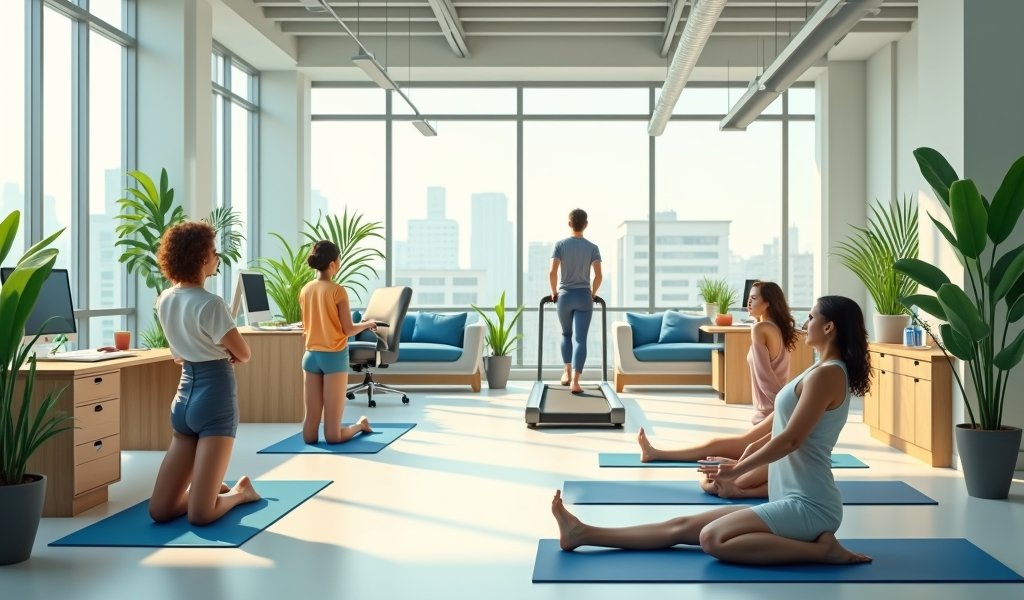
Fitness Solution #1: On-Site Fitness Centers
Nothing says “we’re serious about your health” quite like dedicating valuable real estate to employee fitness. On-site fitness centers eliminate the “I don’t have time to get to the gym” excuse faster than you can say “lunch break workout.”
They provide unparalleled convenience, allowing employees to squeeze in exercise before work, during breaks, or after hours without the commute to an external facility. For many employees, this proximity to fitness equipment can be the difference between consistent exercise and none at all.
Implementing an on-site fitness center requires careful consideration of space and equipment needs. Even a modest 1,000-square-foot space can accommodate basic cardio equipment, free weights, and functional training areas. The investment varies widely based on scope, with basic facilities starting around $30,000 and premium centers reaching into six figures.
Staffing options range from unstaffed facilities with basic maintenance to fully staffed centers with professional trainers. Many companies find success with a hybrid model, offering scheduled classes and trainer hours while allowing 24/7 access for independent workouts.
Success stories abound in this arena. While not every company can match Google’s multiple fitness centers with over 100 classes weekly, even small businesses have created effective on-site fitness spaces that boost employee satisfaction and physical activity levels. The key is tailoring the facility to your company’s specific needs and culture.
Fitness Solution #2: Corporate Fitness Partnerships
For companies lacking the space or resources for on-site facilities, corporate partnerships with local gyms and fitness providers offer an excellent alternative. Like a strategic business alliance, these partnerships create win-win scenarios: employees gain affordable access to professional fitness facilities, while fitness centers secure a steady stream of new members.
The most common approach involves negotiating discounted membership rates or subsidies for employees. Some companies cover a percentage of monthly dues (typically 25-100%), while others provide a flat contribution toward any fitness membership of the employee’s choosing.
When evaluating potential fitness partners, consider factors beyond just price. Location convenience, facility quality, class variety, and hours of operation all significantly impact utilization. The best gym discount in the world won’t help if employees don’t actually use it.
For businesses with multiple locations or remote workers, consider partnering with national chains or networks like ClassPass that offer broader geographic coverage. This ensures equitable access to fitness benefits regardless of where employees are based.
Measuring utilization is crucial for assessing program effectiveness. Many fitness centers provide corporate partners with anonymized usage data, allowing you to track participation rates without compromising employee privacy. Regular satisfaction surveys can also help gauge value and identify potential improvements to the partnership.
Fitness Solution #3: Virtual Fitness Programs
The digital fitness revolution has transformed home workouts from Jane Fonda VHS tapes to sophisticated, interactive experiences – and corporate wellness programs are riding this digital wave. Virtual fitness programs have emerged as the Swiss Army knife of corporate wellness: flexible, accessible, and remarkably effective for diverse workforces.
For companies with remote or hybrid workforces spread across different locations, virtual fitness programs provide equitable access to wellness resources. Employees can participate from anywhere with an internet connection, eliminating geographic barriers to wellness program participation.
Options range from partnerships with established platforms like Peloton Corporate Wellness and ClassPass Digital to customized company-specific fitness apps. Many companies find success with a hybrid approach that combines digital resources with in-person options, creating a wellness ecosystem that meets diverse employee preferences.
The cost-effectiveness of virtual solutions is particularly appealing. With per-employee costs often ranging from $5-15 monthly (compared to $30-100 for gym memberships), digital fitness platforms allow companies to extend wellness benefits to their entire workforce without breaking the budget.
These platforms also provide valuable usage data that helps wellness administrators understand participation patterns and preferences. This insight allows for continual program refinement and targeted communications to boost engagement among different employee segments.
Fitness Solution #4: Wellness Challenges and Gamification
Nothing motivates humans quite like friendly competition and the pursuit of achievements – principles that smart wellness programs leverage through gamification. Well-designed fitness challenges transform exercise from a chore into a game, tapping into our natural competitive spirit and desire for recognition.
The most successful challenges balance competition with inclusivity, allowing participants at all fitness levels to experience success. Step challenges remain perpetually popular for their simplicity and accessibility – everyone can count steps, whether they’re marathon runners or just beginning their fitness journey.
More creative approaches include “around the world” challenges (tracking collective miles to virtually circumnavigate the globe) or “activity bingo” with various exercise types. The key is creating challenges that feel achievable yet motivating for your specific workforce demographics.
Technology has revolutionized challenge implementation, with platforms like Wellable, MoveSpring, and Challenges by Yes.Fit providing turnkey solutions for tracking, communication, and motivation. Many of these platforms integrate with popular fitness wearables, automatically syncing data to reduce participation barriers.
Incentive structures significantly impact participation rates. While financial rewards can be effective (think insurance premium discounts or cash bonuses), non-monetary incentives often drive surprisingly strong engagement. Company recognition, charitable donations, extra time off, or even small trophies can motivate participation when presented within a compelling challenge framework.
Fitness Solution #5: Holistic Wellness Approaches
Treating fitness as an isolated goal rather than part of a comprehensive wellness strategy is like trying to build a house with only a hammer – you’re missing critical tools for success. The most effective corporate wellness programs recognize that physical fitness exists within a broader wellness ecosystem that includes mental health, nutrition, sleep, and stress management.
This holistic approach acknowledges the interconnected nature of wellness factors. Mental wellbeing impacts physical activity levels, whole food nutrition affects energy for exercise, and stress influences both eating habits and workout consistency. By addressing these connections, holistic programs help employees build sustainable healthy lifestyles rather than compartmentalized fitness routines.
Mindfulness and stress reduction programs have moved from wellness fringe to mainstream, with good reason. Companies like Aetna implemented mindfulness programs that reduced employee stress by 28% and improved productivity by 62 minutes per week – translating to approximately $3,000 per employee annually in recovered economic value, according to a study published in the Journal of Occupational Health Psychology.
Nutritional support complements fitness initiatives by addressing the fuel side of the energy equation. Options range from nutrition seminars and cooking demonstrations to healthy food options in cafeterias and vending machines. Consider bringing in registered dietitians for lunch-and-learns or offering plant-based meal plans as resources for employees looking to improve their eating habits.
Sleep improvement programs represent another frontier in holistic wellness. With sleep deficiency linked to reduced productivity, increased error rates, and higher healthcare utilization, helping employees improve sleep quality offers substantial returns. Education about sleep hygiene, screenings for sleep disorders, and even nap rooms (popularized by companies like Google and Nike) can form part of a comprehensive sleep wellness strategy.

Fitness Solution #6: Flexible Wellness Stipends
One-size-fits-all wellness programs often end up fitting no one particularly well. Like offering only one shoe size to your entire workforce, standardized programs inevitably leave many employees with benefits that don’t quite match their needs or preferences. Flexible wellness stipends solve this problem by putting choice in employees’ hands.
These stipends provide employees with a designated amount (typically $300-1,200 annually) to spend on approved wellness activities and services. The beauty of this approach lies in its personalization: running enthusiasts can purchase shoes and race entries, yoga practitioners can attend studios, and swimmers can secure pool memberships – all supported by the same program.
Implementation requires clear guidelines about eligible expenses. Most companies include obvious fitness costs (gym memberships, fitness equipment, exercise classes) along with related wellness expenses like nutritional counseling, wellness apps, or even outdoor recreation gear. The key is establishing boundaries while maintaining sufficient flexibility to accommodate diverse wellness preferences.
Administrative considerations include selecting a management system (options range from simple reimbursement processes to dedicated wellness stipend platforms like Compt or Forma) and determining payment frequency. Some companies provide the full amount upfront, while others distribute funds quarterly or monthly to encourage regular wellness activities.
Regardless of implementation details, the fundamental value of stipend programs lies in their acknowledgment of employee autonomy. By trusting employees to make appropriate wellness choices rather than prescribing specific solutions, these programs often achieve higher satisfaction and engagement rates than more restrictive approaches.
Fitness Solution #7: Active Workplace Design
Even the most comprehensive fitness benefits can’t counteract the effects of spending eight-plus hours daily in sedentary environments. Active workplace design tackles this challenge by integrating movement opportunities into the physical workspace – essentially making activity the path of least resistance rather than something employees must schedule separately.
Ergonomic workstations serve as the foundation, with adjustable chairs and desks that support proper posture and reduce physical strain. Standing desks represent the next level, allowing employees to alternate between seated and standing positions throughout the day. Research from the Mayo Clinic shows that even this simple change can increase calorie expenditure by 170 calories daily – equivalent to losing about 18 pounds annually if consistently utilized.
Walking meetings transform passive discussions into active engagements. Beyond the physical benefits, these movement-based meetings often improve creativity and reduce meeting time – a rare triple-win for health, productivity, and calendar management. Companies like Humana and Apple have embraced this concept, with specially designed walking paths or meeting routes.
Even without major office renovations, simple design tweaks can encourage movement: centrally located printers and trash bins, attractive stairwells that invite use over elevators, and open areas suitable for stretch breaks or informal standing meetings. The goal isn’t to force constant movement, but rather to make it a natural, integrated part of the workday.
For remote workers, virtual ergonomic assessments and home office stipends can help create healthier work environments. Some companies even provide video-based “movement breaks” throughout the day, prompting employees to stand, stretch, and reset their posture regardless of where they’re working.
Implementation and Measurement
Like any business initiative, successful wellness programs require strategic planning, leadership support, effective communication, and meaningful measurement. The difference between wellness programs that transform company culture and those that become forgotten initiatives often lies in these implementation fundamentals.
Developing a strategic wellness plan starts with understanding your specific workforce – their needs, preferences, challenges, and current health status. Anonymous health risk assessments and interest surveys provide valuable baseline data for program design. This foundation allows you to select and implement wellness solutions that address your company’s unique challenges rather than simply following general best practices.
Leadership buy-in remains the single strongest predictor of wellness program success. When executives visibly participate in and champion wellness initiatives, employee participation rates increase dramatically. This support must extend beyond mere approval to active advocacy, with leaders modeling healthy behaviors and publicly recognizing the program’s importance.
Communication strategies should match the energy of your program. Launching a wellness initiative with a single email announcement is like whispering in a crowded room – few will notice. Successful programs use multiple channels (company meetings, dedicated wellness platforms, email campaigns, physical signage) and maintain consistent communication that evolves from initial awareness to ongoing engagement.
Meaningful measurement requires clearly defined success metrics aligned with program goals. While healthcare cost reduction provides a compelling financial case, consider tracking additional indicators like participation rates, health risk changes, employee satisfaction, absenteeism, and productivity measures. Establishing baseline measurements before program implementation allows for meaningful comparisons that demonstrate program impact.
Conclusion
The seven fitness solutions outlined in this guide provide a comprehensive toolkit for companies seeking to enhance employee wellbeing while controlling healthcare costs. Like pieces of a puzzle, these solutions can be combined and customized to create a program perfectly fitted to your organization’s unique needs and resources.
Implementing an effective corporate wellness program isn’t about checking a box or following a trend – it’s about creating fundamental change in how your organization supports employee health. The most successful programs start with clear goals, secure leadership support, select appropriate wellness solutions, communicate effectively, and measure results – then refine based on what they learn.
The future of corporate wellness promises even more personalization through advanced health data analytics, integration with wearable technology, and AI-powered coaching. However, the fundamental principle remains unchanged: investing in employee wellbeing is both a human-centered value and a sound business strategy.
Remember: a corporate wellness program is like a garden – it requires thoughtful planning, consistent attention, and occasional adjustments to flourish. With the right approach, your program can yield a bountiful harvest of healthier, happier, and more productive employees for years to come.
Frequently Asked Questions
What is the ROI of corporate wellness programs?
Studies show an average return of $3.27 for every dollar spent on wellness programs. This ROI comes from reduced healthcare costs, decreased absenteeism, and improved productivity.
How do I increase employee participation in wellness programs?
Boost participation through leadership involvement, effective communication across multiple channels, and incentives that matter to employees. Offering variety and choice also significantly increases engagement rates.
What are the most popular corporate wellness initiatives?
Step challenges, fitness subsidies, mental health resources, and nutrition education consistently rank as employee favorites. Virtual fitness options have also gained tremendous popularity since the pandemic.
How long does it take to see results from a wellness program?
Some benefits like improved morale and engagement may appear within 3-6 months. Financial returns typically take 12-24 months to fully materialize as health behaviors change gradually.
Can small businesses afford effective wellness programs?
Absolutely! Small businesses can implement cost-effective solutions like walking groups, wellness challenges, and fitness app subscriptions. The key is starting small, measuring impact, and scaling successful initiatives.