
Overview
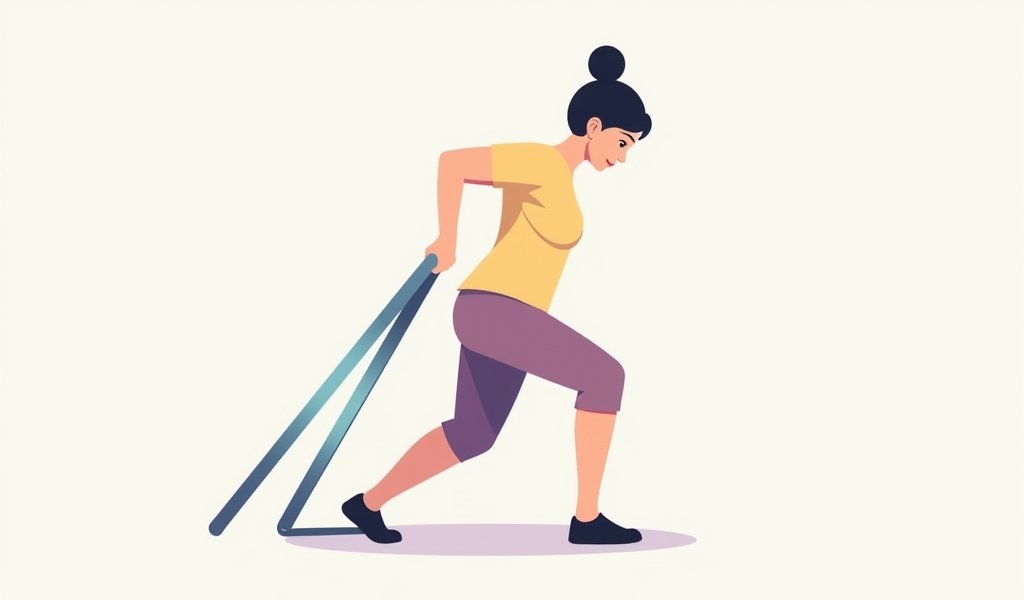
Just when you thought your Achilles tendon was only useful for getting shot with mythological arrows, this guide delivers ten essential exercises to heal a partial tear through a structured rehabilitation approach. The recovery journey spans 3-4 months, progressing from gentle mobility exercises like ankle alphabets to advanced movements like eccentric heel drops, all while emphasizing proper timing, gradual progression, and attentiveness to warning signs that indicate when to back off.
Table of Contents
- Understanding Partial Achilles Tear
- Importance of Proper Rehabilitation
- When to Start Exercises
- Top 10 Exercises for Recovery
- Gradual Progression Plan
- Complementary Recovery Strategies
- Warning Signs to Watch For
- Conclusion
- Frequently Asked Questions
Understanding Partial Achilles Tear
A partial Achilles tear can be a frustrating setback for anyone leading an active lifestyle. Unlike a complete rupture, a partial tear of the Achilles tendon involves damage to some, but not all, of the tendon fibers connecting your calf muscles to your heel bone. These injuries typically occur during high-intensity activities that place sudden stress on the tendon, such as sprinting, jumping, or abrupt directional changes.
The good news? With proper care and targeted exercises, most people with partial Achilles tears can make a full recovery without surgical intervention. As a sports medicine physician with over 15 years of experience, I’ve guided countless patients through successful rehabilitation programs. The key is understanding that recovery requires patience, consistency, and a gradual approach to rebuilding strength and mobility.
Symptoms of a partial Achilles tear typically include moderate to severe pain behind the ankle, swelling, stiffness, and difficulty bearing weight or pushing off with the affected foot. You might also notice a “crunching” sensation when pressing on the tendon. If you’re experiencing these symptoms, it’s essential to consult with a healthcare provider for proper diagnosis before beginning any exercise program.
Importance of Proper Rehabilitation
Rehabilitation isn’t just about healing—it’s about rebuilding a stronger, more resilient tendon. Research published in the Medicine & Science in Sports & Exercise journal shows that appropriate exercise therapy not only promotes tissue healing but also improves the structural integrity of the tendon, potentially reducing future injury risk.
Why is a structured approach so crucial? The Achilles tendon must withstand forces up to 12 times your body weight during running activities. Without proper rehabilitation, you risk developing chronic tendinopathy, persistent weakness, or even a complete rupture down the line. A comprehensive recovery program addresses not just the tendon itself but also any contributing factors like calf tightness, ankle mobility limitations, or biomechanical issues.
The exercises I’m sharing today represent the gold standard in Achilles rehabilitation. They’ve been selected based on both clinical research and my extensive experience working with patients ranging from weekend warriors to professional athletes. Each exercise serves a specific purpose in the recovery journey, targeting different aspects of healing and functional restoration.

When to Start Exercises
Timing is everything when recovering from a partial Achilles tear. The initial phase after injury typically requires rest, ice, compression, and elevation (RICE protocol) to control inflammation and pain. Most healthcare providers recommend waiting until acute pain and swelling have subsided before beginning rehabilitation exercises—usually 1-2 weeks post-injury, depending on severity.
A good rule of thumb: you should be able to bear weight on the affected leg with minimal discomfort before starting gentle exercises. Listen to your body throughout this process. Some mild discomfort during exercises is normal, but sharp or increasing pain is a signal to stop and consult your healthcare provider. As noted in research from the Journal of Orthopaedic & Sports Physical Therapy, respecting tissue healing timeframes is crucial for optimal recovery.
Remember that recovery timelines vary significantly based on the extent of the tear, your age, overall health, and compliance with treatment recommendations. Some individuals may progress through rehabilitation in 6-8 weeks, while others might require 3-4 months before returning to pre-injury activities. Patience pays dividends in Achilles rehabilitation—rushing the process often leads to setbacks.
Top 10 Exercises for Recovery
The following exercises should be performed in a progressive manner as your healing advances. Begin with the first few exercises during early recovery, then gradually incorporate the more challenging ones as your strength and comfort improve.
1. Ankle Alphabet
This gentle mobility exercise helps maintain range of motion without stressing the healing tendon.
- Sit with your leg extended and elevated on a chair or ottoman
- Using your big toe as a “pencil,” trace each letter of the alphabet in the air
- Move only from your ankle, keeping your leg stationary
- Complete the full alphabet once, rest, and repeat if comfortable
Perform this exercise 2-3 times daily during the early recovery phase. The subtle movements promote circulation without placing significant load on the injured tendon.
2. Towel Scrunches
This exercise activates the intrinsic foot muscles, which play a supporting role in Achilles function.
- Sit in a chair with a small towel laid flat on the floor
- Place your foot on the towel and use your toes to scrunch the towel toward you
- Release and repeat 10-15 times
- Progress by placing a small weight on the end of the towel
This seemingly simple exercise engages the entire kinetic chain from your foot through your calf, promoting coordinated muscle activity that supports healing.
3. Seated Heel Raises
This introduces gentle loading to the tendon in a controlled position.
- Sit in a chair with feet flat on the floor and knees bent at 90 degrees
- Slowly raise your heels off the floor, keeping the balls of your feet in contact with the ground
- Hold for 2-3 seconds at the top
- Lower with control to the starting position
- Begin with 2 sets of 10 repetitions, gradually increasing to 3 sets of 15
Focus on quality over quantity. According to research from the British Journal of Sports Medicine, slow, controlled movements are more beneficial for tendon healing than rapid ones.
4. Isometric Heel Raises
This static strengthening exercise builds tendon resilience with minimal stress.
- Stand with your feet hip-width apart, holding onto a stable surface for balance
- Rise onto the balls of both feet
- Hold this raised position for 30-60 seconds
- Slowly lower back down
- Rest 60 seconds and repeat 3-5 times
Isometric contractions have been shown to reduce pain while promoting strength gains in tendon rehabilitation protocols. As you progress, try performing these with the injured leg bearing more weight.
5. Resistance Band Dorsiflexion
This exercise strengthens the anterior tibialis muscle, creating better muscle balance around the ankle.
- Sit with your leg extended and loop a resistance band around your foot, securing the other end to a stable object
- Pull your toes and foot up toward your shin against the band’s resistance
- Hold for 2 seconds, then return to the starting position with control
- Complete 3 sets of 12-15 repetitions
Balanced strength between opposing muscle groups is crucial for proper biomechanics and preventing re-injury. Start with light resistance and progress gradually as comfort allows.
6. Eccentric Heel Drops
This is the gold standard exercise for Achilles rehabilitation, backed by extensive research.
- Stand on the edge of a step with your heels hanging off
- Rise onto your toes using both feet
- Shift your weight to the injured leg
- Slowly lower your heel below the level of the step (the eccentric phase)
- Return to the starting position using both feet
- Start with 2 sets of 10 repetitions, gradually building to 3 sets of 15
The eccentric (lengthening) phase specifically targets tendon remodeling and strengthening. A landmark study in the Scandinavian Journal of Medicine & Science in Sports demonstrated that eccentric training produces superior outcomes for Achilles tendon injuries compared to traditional concentric exercises.
Complementary Recovery Strategies
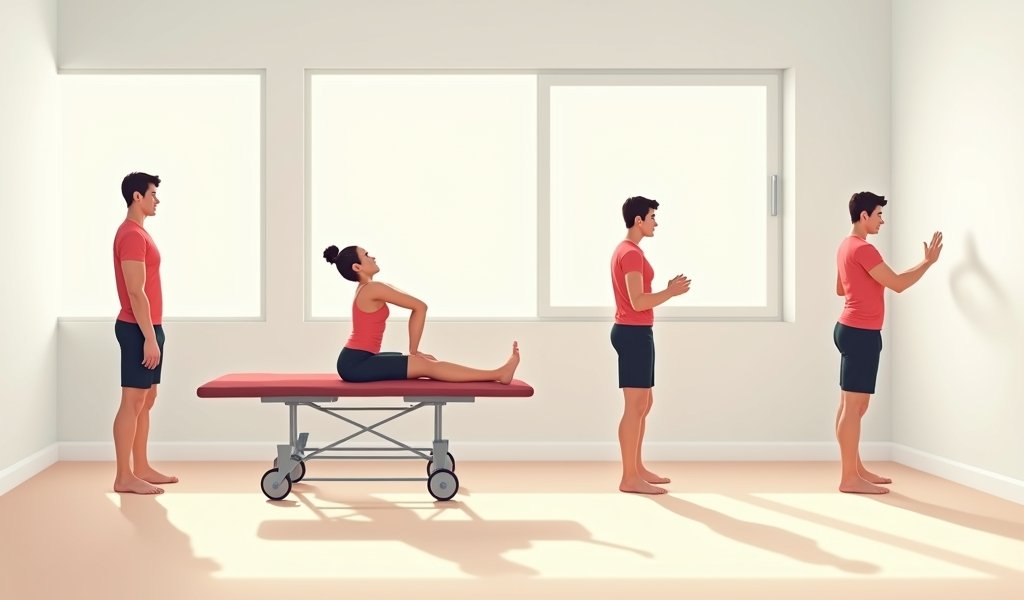
Exercise is just one component of a comprehensive recovery plan for a partial Achilles tear. To optimize healing and prevent future issues, consider these complementary approaches:
7. Calf Stretches
Gentle stretching helps restore flexibility without overloading the healing tendon.
- Stand facing a wall with your hands placed on the wall at shoulder height
- Place the injured leg behind you, keeping the heel down and knee straight
- Gently lean forward until you feel a mild stretch in the calf
- Hold for 30 seconds and repeat 3-5 times
Perform this stretch only after the acute phase has passed, typically 2-3 weeks post-injury. Never stretch to the point of pain.
8. Balance Training
Proprioceptive exercises help restore neuromuscular control and prevent future injuries.
- Stand on the injured leg next to a stable surface for support if needed
- Hold the position for 30 seconds, working up to 60 seconds over time
- Progress by closing your eyes or standing on an unstable surface like a foam pad
- Complete 2-3 sets daily
Research shows that proprioceptive training reduces re-injury rates by improving the body’s ability to sense and respond to positional changes.
9. Walking Heel-to-Toe
This functional exercise retrains normal gait patterns as healing progresses.
- Walk slowly and deliberately, placing your heel down first, then rolling through to your toes
- Focus on pushing off with your toes at the end of each step
- Start with short distances (10 feet) and gradually increase
- Practice for 5 minutes, 2-3 times daily
Many people develop altered walking patterns after Achilles injuries to avoid pain. This exercise helps restore proper biomechanics.
10. Squat-to-Calf Raise Progression
This advanced exercise integrates calf function with full-body movement patterns.
- Stand with feet shoulder-width apart
- Perform a partial squat (descending only about 1/4 of your normal depth)
- As you rise from the squat, continue the movement into a calf raise
- Lower with control to the starting position
- Complete 2-3 sets of 10-12 repetitions
Only attempt this exercise in the later stages of rehabilitation when single-leg heel raises can be performed comfortably with full body weight.
Gradual Progression Plan
Recovery from a partial Achilles tear isn’t a linear process, but the following timeline provides a general framework for exercise progression:
Weeks 1-2 (Acute Phase): Focus on RICE protocol and gentle movement. Exercises 1-2 can usually be started during this period, emphasizing pain-free motion rather than strengthening.
Weeks 3-4 (Early Healing Phase): Introduce exercises 3-5 as pain allows. Continue with previous exercises, gradually increasing repetitions. Mild discomfort is acceptable, but sharp pain should be avoided.
Weeks 5-8 (Strengthening Phase): Add exercises 6-8 to your routine. Begin with minimal load and gradually progress. This is a critical period where the tendon is gaining strength but remains vulnerable to overloading.
Weeks 9-12 (Functional Phase): Incorporate exercises 9-10 as comfort permits. Start integrating activity-specific movements relevant to your sport or daily activities. Continue with previous exercises, focusing on quality and control.
Remember that these timeframes are approximate. Your personal recovery may progress faster or slower depending on various factors. Regular follow-ups with your healthcare provider will help determine when you’re ready to advance to the next phase.
Warning Signs to Watch For
While some discomfort during rehabilitation is normal, certain symptoms should prompt you to pause exercises and consult your healthcare provider:
- Sharp, stabbing pain during or after exercises
- Increased swelling or warmth around the tendon
- Morning pain and stiffness that worsens rather than improves over time
- New clicking or popping sensations in the tendon
- Inability to bear weight on the affected leg
The principle of “no pain, no gain” does not apply to Achilles rehabilitation! Pushing through significant pain can delay healing or cause further damage. A mild stretching sensation or muscle fatigue is acceptable, but actual pain is your body’s warning signal.
Be particularly cautious during transitions between rehabilitation phases. This is when many setbacks occur as people often increase activity too quickly. A good rule is to increase exercise intensity or duration by no more than 10-15% per week.
Conclusion
Recovering from a partial Achilles tear requires dedication, patience, and a structured approach. The 10 exercises outlined in this guide provide a comprehensive framework for rehabilitation, addressing mobility, strength, proprioception, and functional movement patterns. By following this progressive program and listening to your body’s signals, you can significantly improve your chances of a complete recovery.
Remember that healing timeframes vary between individuals, and comparing your progress to others’ experiences may lead to frustration or inappropriate exercise progression. Focus instead on consistent improvement, however gradual it may be. Small, steady gains compound over time into significant recovery.
If you’re unsure about any aspect of your rehabilitation, don’t hesitate to consult with a physical therapist or sports medicine physician. These professionals can provide personalized guidance based on your specific injury and recovery goals. With the right approach, most people with partial Achilles tears can return to their previous level of activity and enjoy an active, pain-free lifestyle.
Frequently Asked Questions
How long does it take to recover from a partial Achilles tear?
Recovery typically takes 6-12 weeks for moderate tears, though complete return to high-impact activities may take 3-6 months. Timeline varies based on tear severity, your age, overall health, and adherence to rehabilitation protocols.
Can I continue exercising with a partial Achilles tear?
Low-impact activities like swimming or stationary biking may be appropriate after the acute phase if they don’t cause pain. Avoid running, jumping, or activities that stress the Achilles until cleared by your healthcare provider.
Do I need surgery for a partial Achilles tear?
Most partial tears heal successfully with conservative treatment including rest, physical therapy, and gradual rehabilitation. Surgery is typically reserved for complete ruptures or partial tears that fail to improve with non-surgical management.
What shoes are best during Achilles tear recovery?
Supportive shoes with a slight heel lift (0.5-1 inch) reduce strain on the Achilles during healing. Avoid flat shoes, barefoot walking, or high heels until recovery is complete.
Can I prevent future Achilles tears?
Regular strengthening exercises, proper warm-up before activities, gradual training progression, and appropriate footwear all reduce risk. Listening to your body and addressing early warning signs of tendon irritation is also crucial for prevention.