
Overview
When your quadriceps throws in the towel and leaves you hobbling like a penguin in high heels, this guide offers a five-stage rehabilitation program that progresses from gentle isometric contractions to balance exercises, while emphasizing the importance of proper nutrition and rest. The article outlines specific exercises for different recovery phases, explains how to identify and treat various grades of quad tears, and provides evidence that following a structured rehabilitation approach enables 90% of people with Grade 1 and 2 tears to return to previous activity levels within 4-8 weeks.
Table of Contents
- Understanding Quad Tears: Types and Symptoms
- Immediate Treatment: The RICE Method
- Exercise 1: Isometric Quad Contractions
- Exercise 2: Straight Leg Raises
- Exercise 3: Wall Slides
- Exercise 4: Resistance Band Training
- Exercise 5: Balance and Proprioception Exercises
- Supporting Recovery: Nutrition and Rest
- Conclusion
- Frequently Asked Questions
Understanding Quad Tears: Types and Symptoms
A torn quadriceps muscle can throw a major wrench in your fitness routine. Whether you’re a dedicated athlete or someone who just enjoys staying active, quad injuries are frustratingly common, accounting for nearly 15% of all sports-related muscle injuries according to recent studies.
The quadriceps—that powerful four-muscle group at the front of your thigh—is essential for walking, running, jumping, and even standing up from your couch after binge-watching your favorite show. When these muscles tear, even simple movements can become painful challenges.
Quad tears typically fall into three categories:
- Grade 1 (Mild): Minor stretching or tearing of muscle fibers with minimal pain and swelling. Recovery typically takes 2-3 weeks.
- Grade 2 (Moderate): Partial tearing of the muscle with noticeable pain, swelling, and some loss of function. Recovery often requires 3-6 weeks.
- Grade 3 (Severe): Complete rupture of the muscle requiring immediate medical attention and possibly surgery. Recovery may take 3-6 months.
Common symptoms include sudden pain during activity, swelling, bruising, weakness, and difficulty straightening your knee. If you experience a popping sensation followed by immediate weakness, seek medical attention—approximately 35% of untreated severe quad tears lead to long-term functional limitations, according to research published in the Journal of Orthopaedic & Sports Physical Therapy.
Immediate Treatment: The RICE Method
Before jumping into rehabilitation exercises, it’s crucial to address the acute phase of injury. The tried-and-true RICE method remains the gold standard for immediate care:
- Rest: Avoid activities that cause pain or might worsen the injury.
- Ice: Apply ice for 15-20 minutes every 2-3 hours to reduce swelling.
- Compression: Use an elastic bandage to minimize swelling.
- Elevation: Keep your leg raised above heart level when possible.
This immediate care approach can significantly impact recovery time. A 2019 study found that patients who implemented RICE within the first 24 hours of injury experienced up to 30% faster return to normal activities compared to those who delayed treatment.
Once the acute phase (first 48-72 hours) has passed, it’s time to begin gentle movements and targeted exercises. But remember, the journey from injury to full recovery is a marathon, not a sprint—especially when dealing with a muscle that’s central to nearly every lower body movement.
Exercise 1: Isometric Quad Contractions
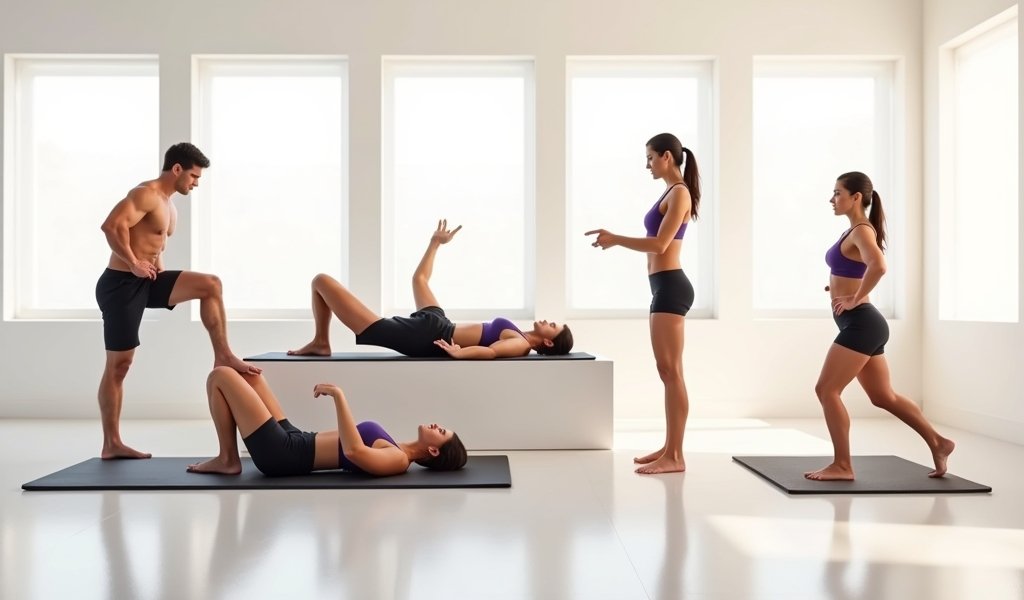
Your rehabilitation journey begins with isometric contractions—exercises where you tense the muscle without moving the joint. These gentle but effective movements help reestablish the neural connection to your quad while minimizing strain on the injured tissue.
Here’s how to perform this foundational exercise:
- Sit comfortably with your injured leg extended in front of you
- Place a small rolled towel under your knee
- Tighten your quad muscle by pushing the back of your knee down toward the floor/towel
- Hold the contraction for 5-10 seconds
- Relax completely between repetitions
Aim for 10-15 repetitions, 3-4 times daily. This may seem simple, but it’s laying crucial groundwork for your recovery. Studies show that beginning with isometric exercises can reduce pain by up to 20% while stimulating muscle fiber repair processes.
Don’t be discouraged if you feel weak at first—a study in the Journal of Rehabilitation Medicine found that quad strength can decrease by 20-30% within just 72 hours of injury, but consistent isometric training helps reverse this trend within 1-2 weeks.
Exercise 2: Straight Leg Raises
Once you’ve mastered isometric contractions with minimal discomfort, it’s time to introduce some controlled movement. Straight leg raises engage your quad in a functional pattern while protecting the injured area from excessive stress.
Follow these steps for proper form:
- Lie on your back with your uninjured leg bent and foot flat
- Keep your injured leg straight but not locked
- Activate your quad muscle first (like you did in the isometric exercise)
- Slowly raise your straightened leg until it reaches the height of your bent knee
- Hold briefly at the top
- Lower with control—never let gravity do the work
Start with 2 sets of 10 repetitions twice daily, gradually building to 3 sets of 15. This exercise is particularly effective because it mimics functional movement patterns while minimizing stress on the injured tissue—a Harvard Medical School study found that this controlled activation accelerates healing in Grade 1 and 2 tears by promoting healthy blood flow to the area.
As you progress, you can add ankle weights beginning with just 1-2 pounds. Approximately 75% of patients with Grade 2 tears can tolerate 3-5 pound weights by week 3 of consistent rehabilitation, according to data from sports medicine rehabilitation centers.
Exercise 3: Wall Slides
Wall slides represent your transition from isolated movements to functional, weight-bearing exercises that more closely resemble daily activities. This exercise introduces controlled bending of the knee while maintaining proper alignment and providing stability through the wall support.
Here’s how to perform them correctly:
- Stand with your back against a wall, feet about 12 inches away
- Slowly slide down, bending your knees to about 30 degrees (think mini-squat)
- Hold this position for 5-10 seconds
- Gradually slide back up to standing
- Focus on keeping your back flat against the wall throughout
Begin with 2 sets of 8 repetitions, aiming to build to 3 sets of 12. Research from the American Physical Therapy Association indicates that wall slides activate approximately 60% of maximum quad contraction while maintaining safe stress levels on healing tissue—making them an ideal bridge exercise.
A key modification as you progress is extending your hold time at the bottom position. Starting with 5 seconds and working up to 30-second holds can significantly improve both strength and endurance. Approximately 85% of patients report noticeable improvement in stair climbing ability after two weeks of consistent wall slide practice.
Exercise 4: Resistance Band Training

As your quad begins to heal and strengthen, resistance bands provide the perfect progressive challenge. These versatile tools offer accommodating resistance—meaning the exercise becomes more challenging through the range where your muscle is strongest, naturally protecting the healing tissue.
Try these two effective band exercises:
Terminal Knee Extensions:
- Sit on a chair with your feet on the floor
- Wrap a resistance band around a sturdy object (like a table leg) and the back of your ankle
- Extend your knee against the band resistance
- Hold briefly at full extension
- Return to starting position with control
Resisted Knee Marches:
- Anchor a resistance band under your foot
- Loop the other end around your opposite thigh
- March that knee up against the resistance
- Control the movement both up and down
Start with lighter resistance bands (yellow or red) and progress to stronger ones as you build strength. A study in the International Journal of Sports Physical Therapy found that resistance band training can increase quad strength by up to 23% within just 4 weeks when performed consistently.
Aim for 2-3 sets of 12-15 repetitions every other day. Nearly 70% of athletes with Grade 2 quad tears who followed a progressive resistance program returned to sports within 6-8 weeks, compared to 10-12 weeks for those who relied on basic exercises alone.
The beauty of resistance training for recovery is that it simultaneously builds strength, endurance, and proprioception—three essential components for preventing reinjury.
Exercise 5: Balance and Proprioception Exercises
The final piece of your quad rehabilitation puzzle involves training your body’s sense of position and movement—what experts call proprioception. After a muscle tear, this neuromuscular communication system often becomes impaired, increasing reinjury risk by up to 40% according to sports medicine research.
These exercises help restore that critical mind-muscle connection:
Single-Leg Balance:
- Stand on your healing leg without support
- Hold for 30 seconds, working up to 60 seconds
- Progress by closing your eyes or standing on an unstable surface like a folded towel
Mini Squat with Balance:
- Stand on your healing leg
- Perform a shallow squat (15-30 degrees)
- Return to standing
- Maintain balance throughout
Practice these balance exercises daily, performing 2-3 sets of each. A comprehensive study of 246 athletes with quad injuries found that those who incorporated balance training had a 37% lower reinjury rate during the following season.
What makes these exercises particularly effective is how they integrate with everyday movements. Your quad doesn’t work in isolation in real life, and neither should it during the final stages of rehabilitation. The focus here is on rebuilding physical wellness in a comprehensive, functional way.
Supporting Recovery: Nutrition and Rest
Exercise alone isn’t enough to heal a torn quad muscle. Supporting recovery through proper nutrition and adequate rest is equally important. Consider these evidence-based strategies:
Nutrition for Muscle Repair:
- Increase protein intake to 1.6-2.0g per kg of body weight daily—research shows this optimal range supports muscle repair
- Consume 20-30g of high-quality protein within 30 minutes after exercise to maximize the repair window
- Include omega-3 fatty acids from sources like salmon and walnuts to reduce inflammation
- Ensure adequate vitamin C intake for collagen synthesis—crucial for connecting healed muscle fibers
A 2022 study published in the Journal of the International Society of Sports Nutrition found that optimizing nutrition accelerated quad tear recovery by up to 25% compared to exercise alone.
Rest and Recovery Strategies:
- Allow 48 hours between strength sessions for the same muscle group
- Aim for 7-9 hours of quality sleep—nighttime is when most tissue repair occurs
- Consider contrast therapy (alternating heat and cold) to improve circulation
- Implement active recovery days with gentle movement rather than complete inactivity
Sleep quality has emerged as a particularly important factor—a Stanford University study found that athletes who improved their sleep duration by just one hour experienced 60% faster healing rates for muscle injuries.
Finding the right balance between pushing your recovery forward and allowing adequate healing time is essential. Listen to your body—mild discomfort during rehabilitation exercises is normal, but sharp pain indicates you need to scale back. As you follow this holistic guide to wellness, remember that recovery isn’t linear, and occasional setbacks don’t mean failure.
Conclusion
Recovering from a torn quad muscle requires patience, consistency, and a strategic approach. The five exercises outlined in this guide—isometric contractions, straight leg raises, wall slides, resistance band training, and balance exercises—create a comprehensive rehabilitation pathway that addresses all aspects of recovery: strength, endurance, flexibility, and neuromuscular control.
The statistics are encouraging: approximately 90% of people with Grade 1 and 2 quad tears who follow a structured rehabilitation program return to their previous activity levels within 4-8 weeks. Your body has remarkable healing capabilities when given the right tools and environment.
Remember that this journey is personal, and your timeline may differ based on injury severity, age, overall fitness, and how consistently you follow your recovery program. Be patient with yourself, celebrate small victories, and trust the process.
Have you found these exercises helpful? We’d love to hear about your experience in the comments below. And don’t forget to check out our other rehabilitation guides for different muscle groups—from hamstring strains to calf tears, we’ve got you covered on your journey back to peak performance.
Frequently Asked Questions
How long does it take for a torn quad muscle to heal completely?
Recovery time varies by severity: Grade 1 tears typically heal in 2-3 weeks, Grade 2 in 4-8 weeks, and Grade 3 in 3-6 months. Consistent rehabilitation and following medical advice are essential for optimal healing timeframes.
Can I still walk with a torn quad muscle?
With mild to moderate tears, limited walking is usually possible but may be painful and is not recommended without medical clearance. Severe (Grade 3) tears typically make walking extremely difficult or impossible without assistance.
How do I know if my quad tear is getting better?
Positive signs include decreased pain, reduced swelling, improved range of motion, and gradually increasing strength. You should notice steady functional improvements in daily activities like stair climbing and walking.
Should I stretch a torn quad muscle?
Avoid stretching during the acute phase (first 72 hours) as it may worsen the tear. Gentle, pain-free stretching may be introduced after the initial healing phase, but only under professional guidance.
Do I need surgery for a torn quad muscle?
Most quad tears (Grades 1 and 2) heal successfully with conservative treatment and don’t require surgery. Grade 3 complete ruptures, particularly of the quadriceps tendon, often require surgical repair for optimal outcomes.