
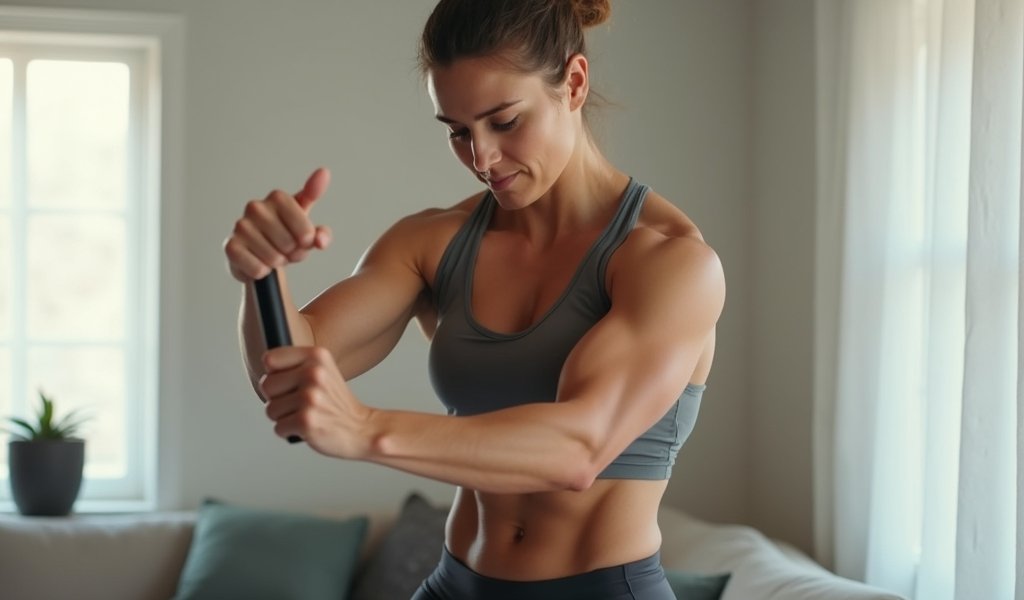
Overview
This article provides a detailed guide to effective bicep workouts that can be done at home with minimal equipment, featuring seven key exercises (doorway curls, household item curls, towel curls, chin-ups, resistance band curls, isometric holds, and spider curls) plus workout routines for all fitness levels. It emphasizes that building impressive biceps doesn’t require a gym membership—just consistent training with proper technique, adequate recovery, and patience to see results that typically appear after 4-6 weeks of dedicated effort.
Table of Contents
- Introduction
- Why Training Your Biceps Matters
- Equipment Needed (Hint: Not Much!)
- The Perfect Warm-Up for Bicep Training
- 7 Proven Bicep Moves for Home Workouts
- Sample Workout Routines for All Levels
- Recovery Tips and Training Frequency
- Conclusion
- Frequently Asked Questions
Flexing from Your Living Room: The Ultimate Guide to Bicep Workouts at Home
For fitness enthusiasts trying to build impressive arms while juggling busy schedules, home-based parents squeezing in workouts during nap time, or remote workers looking to break up their day with something physical—this comprehensive guide to bicep workouts at home is your new best friend. Like a secret weapon in your fitness arsenal, these techniques will transform your living space into an effective arm-sculpting gym. No expensive equipment or membership fees required—just your determination and a few household items. Isn’t it time you discovered how powerful simple, targeted movements can be when done consistently?
As a certified strength coach who’s helped hundreds of clients build impressive arms without setting foot in a commercial gym, I’ve refined these techniques to deliver maximum results with minimal equipment. Let’s explore how you can develop those coveted arm curves and functional strength from the comfort of your own home.
Why Training Your Biceps Matters
Your biceps are like the unsung heroes of your upper body—they’re working behind the scenes in nearly everything you do. From lifting grocery bags to picking up children, these muscles support your daily activities in countless ways. When strengthened properly, they enhance your functional capacity while simultaneously improving your physical appearance.
Beyond aesthetics (though let’s be honest, defined arms look fantastic in a T-shirt), strong biceps stabilize your elbow joints, improve your capacity for pulling movements, and create balance with your triceps for optimal arm function. As research has shown, balanced muscular development reduces injury risk and enhances overall performance.
Meghan, a 34-year-old graphic designer, discovered this firsthand: “Before I started focused bicep training, I’d get sore arms just from carrying my toddler around the zoo for a couple of hours. Six weeks into these home workouts, I noticed everyday tasks becoming significantly easier—plus I love how my arms look in photos now!”
Equipment Needed (Hint: Not Much!)
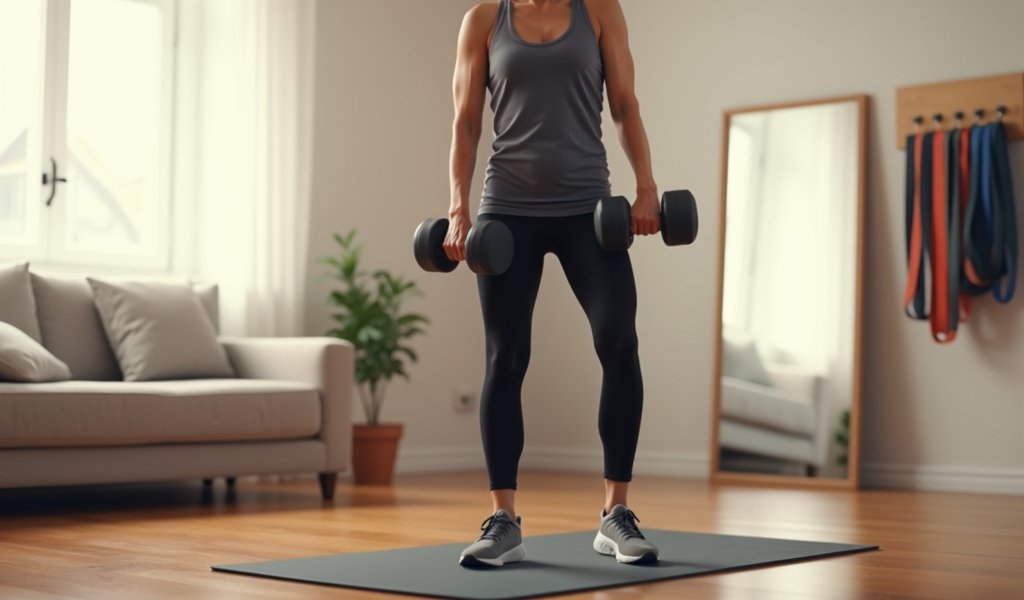
Like a skilled chef who can create a gourmet meal with just a few simple ingredients, you can build impressive biceps with minimal equipment. Here’s what you’ll need:
- Your body weight: Nature’s most perfect resistance tool
- Common household items: Water bottles, books, backpacks, or canned goods
- A sturdy door frame: For certain exercises (and no, you won’t damage it)
- Resistance bands (optional): Inexpensive and incredibly versatile
If you eventually want to invest in equipment, a set of adjustable dumbbells provides excellent versatility for under $100, but they’re completely optional for getting started. As Dr. Stuart McGill, a renowned spine biomechanist, notes, resistance is resistance—whether it comes from fancy equipment or a gallon water jug, your muscles respond to the challenge, not the price tag.
The Perfect Warm-Up for Bicep Training
Skipping your warm-up is like trying to drive a car in freezing weather before letting the engine warm up—technically possible, but asking for trouble. A proper warm-up increases blood flow to the working muscles, enhances neural activation, and prepares your joints for the work ahead.
For bicep-focused training, spend 3-5 minutes on this simple sequence:
- 20 arm circles in each direction (start small, gradually increase size)
- 15 shoulder rolls forward and backward
- 10 wall push-ups to engage opposing muscle groups
- 30 seconds of shadow boxing to increase upper body blood flow
- 10 bicep curls using very light resistance or just body weight
Your muscles should feel warm and slightly pumped—like they’re waking up and ready for action. Research from the American College of Sports Medicine confirms that proper warm-ups not only reduce injury risk but can enhance performance by up to 20%.
7 Proven Bicep Moves for Home Workouts
1. Doorway Bicep Curls
This innovative technique uses isometric resistance against your door frame, making it like a strength-building meditation for your biceps.
How to perform:
- Stand in an open doorway, feet shoulder-width apart
- Place your palms against the doorframe at waist height, as if you’re about to perform a bicep curl
- Position yourself with a slight forward lean
- Push upward against the immovable doorframe while slowly walking your feet back
- Hold for 10-15 seconds while breathing normally
- Release and repeat
Pro tip: Change hand height for different resistance angles. Focus on quality tension rather than duration—your biceps should be quivering by the end of each hold.
Sets and reps: 4 holds of 10-15 seconds per arm with 30 seconds rest
2. Household Item Curls
When life gives you water bottles, do bicep curls! This adaptable exercise proves that effective training doesn’t require fancy equipment.
Choose your “weights”:
- Water bottles (16-20 oz for beginners, 1-gallon jugs for more resistance)
- Canned goods from your pantry
- Books of appropriate weight
- Backpacks filled to desired resistance
Execution:
- Stand with feet shoulder-width apart, core engaged
- Hold your improvised weights with palms facing forward
- Keep elbows pinned to your sides throughout the movement
- Curl the weights toward your shoulders, squeezing your biceps at the top
- Lower with control, fully extending your arms without locking elbows
Carlos, a father of three from Denver, created a progressive system: “I started with soup cans, moved to water bottles, then to a backpack with books. Six months later, my arms had definition I never thought possible without a gym.”
Sets and reps: 3 sets of 10-15 reps with 60 seconds rest
3. Towel Bicep Curls
Like tug-of-war for your biceps, this exercise creates impressive tension with nothing more than a bath towel.
Setup:
- Hold a bath towel horizontally in front of you
- Hands should be shoulder-width apart
- Create tension by trying to “tear” the towel apart
- Maintain this tension throughout the exercise
Movement:
- With tension in the towel, perform a curling motion
- As you curl up, increase the pulling tension on the towel
- Hold at the top for 2 seconds with maximum tension
- Lower slowly while maintaining resistance
Sets and reps: 3 sets of 12-15 reps or until significant muscle fatigue
4. Chin-Up Variations
The chin-up remains the gold standard of bicep builders. If you have a pull-up bar (door-mounted versions are affordable), this exercise is worth mastering.
Standard Chin-Up:
- Grip the bar with palms facing you, hands shoulder-width apart
- Hang with arms fully extended
- Pull your body up until your chin clears the bar
- Lower with control to starting position
Can’t do a full chin-up yet? Try these progressions:
- Negatives: Use a chair to reach the top position, then lower yourself as slowly as possible
- Band-assisted: Loop a resistance band around the bar and place your foot or knee in it for assistance
- Isometric holds: Hold yourself at the top or middle position for time
Sets and reps: 3-4 sets of as many quality reps as possible with 90 seconds rest
5. Resistance Band Curls
Resistance bands are like portable gyms that fit in your drawer. They provide variable resistance that increases as you curl, creating an excellent growth stimulus.
Technique:
- Stand on the middle of your band with feet shoulder-width apart
- Grasp the handles with palms facing forward
- Keeping elbows fixed at your sides, curl the band up toward your shoulders
- Squeeze your biceps at the top before slowly lowering
Variations:
- Alternating arms for greater focus on each side
- Pulse at the top for increased time under tension
- 21s: 7 partial reps from bottom to middle, 7 from middle to top, 7 full range
Sets and reps: 3 sets of 12-15 reps with 60 seconds rest
6. Isometric Bicep Holds
Like a plank for your biceps, isometric holds build tremendous strength and mind-muscle connection.
How to perform:
- Hold any weight (or press against a counter from underneath)
- Position your elbows at 90 degrees, the midpoint of a curl
- Apply force and hold this position, flexing your biceps intensely
- Focus on breathing normally throughout the hold
Sarah, a yoga instructor who added these to her routine, shared: “I was skeptical about static holds, but after adding these twice weekly, my bicep definition improved dramatically, and I gained the strength to finally do pull-ups.”
Sets: 3-4 holds of 30-45 seconds with 60 seconds rest
7. Spider Curls on Floor
This floor-based exercise isolates the biceps beautifully without specialized equipment.
Setup:
- Lie face down on the floor
- Prop yourself up on your elbows, forearms flat on the ground
- Hold your weights (water bottles, cans, etc.) with arms hanging down
Execution:
- From the hanging position, curl the weights up toward your shoulders
- Keep upper arms stationary against the floor
- Squeeze hard at the top of the movement
- Lower with control back to the starting position
Sets and reps: 3 sets of 10-12 reps with 60-90 seconds rest
Sample Workout Routines for All Levels
Like a chef offering recipes for different tastes, here are three workout protocols tailored to your experience level. These aren’t just random exercises thrown together—they’re strategically sequenced for optimal muscle stimulation.
Beginner Home Bicep Workout (2-3 times weekly)
- Household Item Curls: 3 sets of 12 reps
- Doorway Bicep Curls: 3 holds of 10 seconds per arm
- Towel Bicep Curls: 3 sets of 15 reps
- Rest 60 seconds between exercises
Intermediate Home Bicep Workout (3 times weekly)
- Chin-Up Negatives or Band-Assisted Chin-Ups: 3 sets of 6-8 reps
- Resistance Band Curls: 3 sets of 12 reps
- Spider Curls on Floor: 3 sets of 10 reps
- Isometric Bicep Holds: 3 holds of 30 seconds
- Rest 75 seconds between exercises
Advanced Home Bicep Workout (3-4 times weekly)
- Chin-Ups: 4 sets of 8-10 reps
- Heavy Household Item Curls: 3 sets of 10 reps (with slow negatives)
- 21s with Resistance Bands: 3 sets
- Spider Curls: 3 sets of 12 reps
- Isometric Peak Contractions: 4 holds of 20 seconds at full contraction
- Rest 90 seconds between exercises
Michael, a software engineer who followed the intermediate program for three months, reported: “The progress was almost shocking. I started with soup cans and struggled with 10 reps. Now I’m doing weighted chin-ups and my wife keeps asking if I’m sneaking off to a gym somewhere!”
Recovery Tips and Training Frequency
Your biceps, like temperamental artists, need the right conditions to perform their best. Although they’re relatively small muscles that recover more quickly than larger muscle groups, proper recovery remains essential for growth.
Optimal Training Frequency:
- Beginners: 2-3 dedicated bicep sessions weekly
- Intermediate/Advanced: 3-4 sessions weekly
Recovery Enhancement Strategies:
- Prioritize protein intake (aim for 0.7-1g per pound of bodyweight daily)
- Stay hydrated throughout the day
- Get 7-9 hours of quality sleep
- Perform light stretching on rest days
- Consider gentle massage or foam rolling for forearms
Warning Signs of Overtraining:
- Persistent elbow or wrist pain
- Decreased performance over multiple sessions
- Extreme soreness lasting more than 72 hours
- Reduced motivation to train
Jennifer, a 38-year-old accountant, learned this lesson through experience: “I was so excited about my progress that I started doing bicep workouts almost daily. Within two weeks, I developed painful tendonitis. Now I train them just three times weekly with better results and no pain.”
Conclusion: Your Bicep Transformation Begins at Home
Building impressive biceps doesn’t require expensive gym memberships or fancy equipment—just consistent effort and proper technique. The seven proven moves we’ve explored provide everything you need to develop stronger, more defined arms from the comfort of your home. Like tending a garden, bicep development requires regular attention and patience, but the results are well worth the effort.
Remember that visible changes typically begin to appear after 4-6 weeks of consistent training. Track your progress through photos or by noting increases in repetitions or resistance—these tangible metrics can be incredibly motivating when progress seems slow.
Your biceps are waiting to be transformed. With nothing more than household items, a bit of floor space, and the determination to improve, you’re now equipped with everything needed to build the arms you’ve always wanted—right from your living room. Isn’t it time you rolled up your sleeves (literally) and got started?
Frequently Asked Questions
How quickly will I see results from home bicep training?
Most people notice improved strength within 2-3 weeks and visible changes in muscle definition within 6-8 weeks of consistent training. Your personal timeline depends on factors like nutrition, recovery, and genetic predisposition.
Can I build significant bicep size without weights?
Absolutely! Bodyweight exercises like chin-ups, isometric holds, and creative resistance techniques can build impressive biceps. The key is progressive overload—continually challenging your muscles with increasing resistance or difficulty.
How many times per week should I train my biceps?
For optimal results, train biceps 2-3 times weekly if you’re a beginner and 3-4 times weekly if you’re more advanced. Always allow 48 hours between intense bicep sessions for proper recovery.
Do I need to take protein supplements for bicep growth?
Supplements aren’t necessary if you consume adequate protein through your diet (around 0.7-1g per pound of bodyweight daily). Whole food protein sources like chicken, eggs, fish, dairy, and plant proteins provide everything your muscles need to recover and grow.
My wrists hurt during bicep exercises—what should I do?
Wrist pain often stems from improper form or excessive weight. Ensure your wrists remain in a neutral position during exercises, start with lighter resistance, and focus on perfect technique. If pain persists, consult a healthcare professional.
Pingback: 7 Proven Exercise Bands with Handles - achievehealthgoals.com