

Overview
Think your packed schedule means health takes a backseat? This article offers time-efficient strategies for busy professionals to optimize nutrition, exercise, stress management, sleep, and habit formation—proving you don’t need hours of free time to make significant health improvements that enhance both personal wellbeing and professional performance.
Table of Contents
- Understanding the Challenge: Health in a Hectic World
- Nutrition Hacks: Fueling Your Body Efficiently
- Exercise Strategies for the Time-Strapped Professional
- Stress Management: Protecting Your Mental Wellbeing
- Sleep Optimization: Quality Over Quantity
- Staying Consistent: Building Sustainable Habits
- Conclusion: Small Changes, Big Impact
- Frequently Asked Questions
Understanding the Challenge: Health in a Hectic World
In today’s fast-paced professional environment, finding time for health and fitness can feel like searching for a mythical unicorn. As a physician specializing in lifestyle medicine, I’ve worked with countless busy professionals who struggle to balance career demands with personal wellbeing. The challenge isn’t just about finding time—it’s about making strategic choices that yield maximum health benefits with minimal time investment.
The modern workplace often creates what we in healthcare call the “productivity paradox”—the busier we become pursuing success, the less time we allocate to the very health practices that would make us more effective. According to CDC workplace health research, professionals who integrate healthy habits experience higher productivity, fewer sick days, and greater cognitive performance.
The good news? You don’t need hours of free time or complicated regimens to make meaningful health improvements. What you need are evidence-based strategies that work within your constraints. Let’s explore five essential health and fitness hacks specifically designed for the realities of busy professional life—approaches I’ve seen transform the wellbeing of even the most time-constrained executives and professionals.
Nutrition Hacks: Fueling Your Body Efficiently
When time is scarce, nutrition often suffers first. Yet feeding your body properly is non-negotiable for sustained energy, mental clarity, and disease prevention. The key is to make nutrition simple, convenient, and consistent.
Meal preparation doesn’t have to be an all-day Sunday affair. Even dedicating just 30-45 minutes twice weekly can transform your nutrition. Research from the Harvard T.H. Chan School of Public Health indicates that meal planning is associated with better dietary quality and lower obesity rates. Consider these efficient approaches:
- Batch cook versatile proteins like grilled chicken, hard-boiled eggs, or lentils that can be added to various meals throughout the week
- Pre-chop vegetables and store them in glass containers for quick addition to meals or snacks
- Prepare “meal components” rather than complete meals for greater flexibility
Strategic snacking is another powerful tool in your nutritional arsenal. Keep nutrient-dense options readily available to prevent energy crashes and poor food choices during high-stress periods. My successful clients maintain snack stations in their office, car, and home containing:
- Unsalted nuts and seeds (portion-controlled to about ¼ cup)
- Plain Greek yogurt with cinnamon and berries
- Cut vegetables with hummus or guacamole
- Apple or pear slices with almond butter
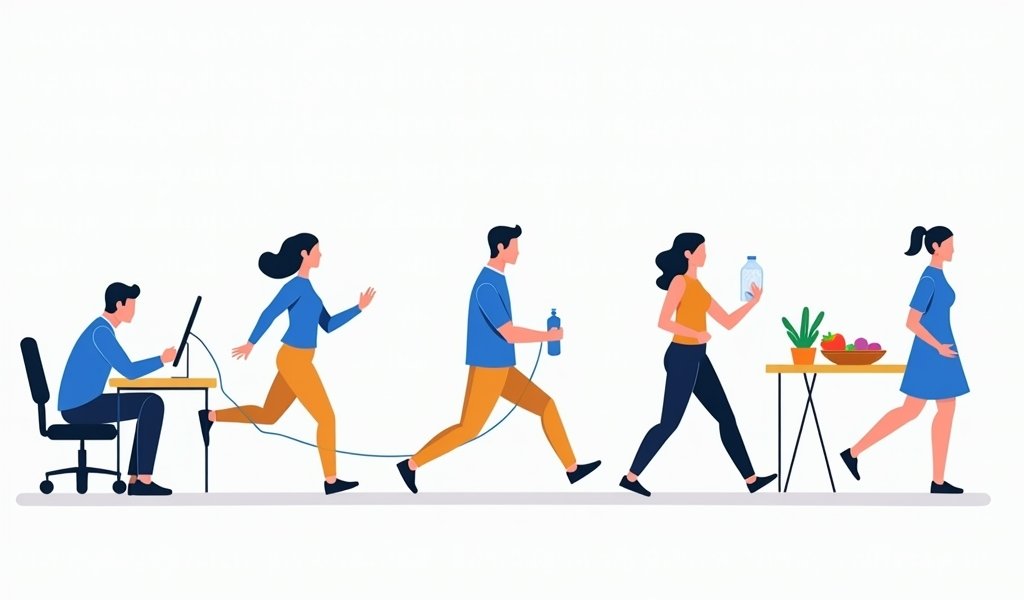
Hydration is perhaps the simplest yet most overlooked nutrition hack. Even mild dehydration can impair cognitive function, energy levels, and mood—precisely what busy professionals can’t afford. Set a visible water bottle on your desk with time markers as a visual reminder. Consider investing in a smart water bottle that tracks intake and sends reminders if you’re particularly forgetful about hydrating throughout the day.
Exercise Strategies for the Time-Strapped Professional
Exercise doesn’t require a 90-minute gym commitment to be effective. In fact, research increasingly supports the efficacy of shorter, strategic workouts for busy individuals. As a health professional, I recommend focusing on exercise quality and consistency rather than duration.
High-Intensity Interval Training (HIIT) has revolutionized how time-constrained professionals approach fitness. These workouts alternate between brief, intense activity periods and recovery phases, delivering cardiovascular and metabolic benefits comparable to much longer steady-state sessions. A study published in the Journal of Physiology found that just 20 minutes of HIIT three times weekly produced similar improvements in cardiorespiratory fitness as 45 minutes of moderate continuous training five times per week.
For optimal results, I recommend this simple HIIT framework that can be completed in just 20 minutes:
- 5-minute dynamic warm-up (arm circles, leg swings, light jogging)
- 10 minutes of intervals (30 seconds maximum effort, 90 seconds recovery)
- 5-minute cool-down and basic stretching
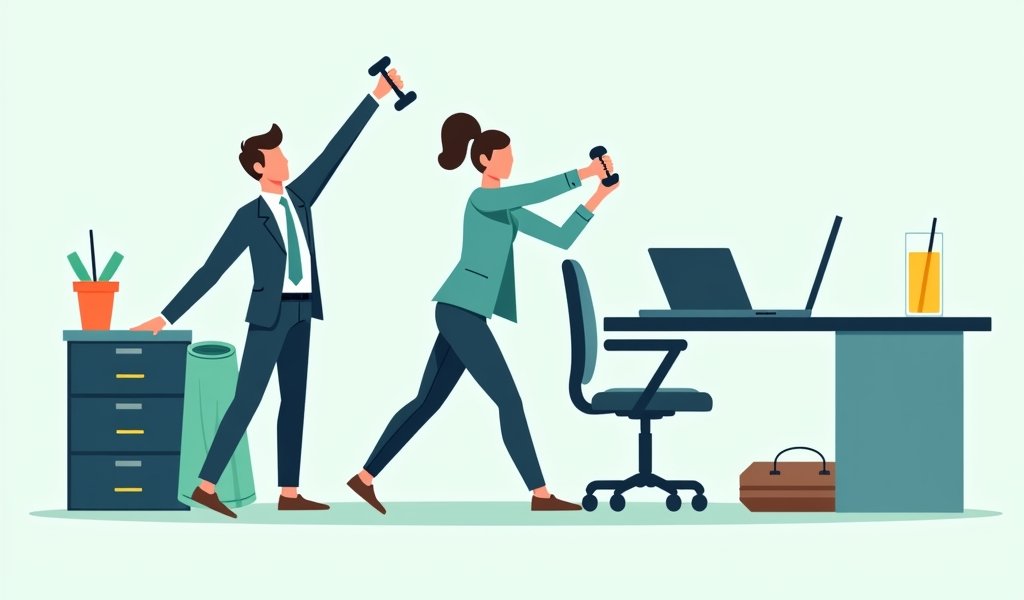
Movement integration throughout your workday is another powerful strategy. Rather than viewing exercise as something separate from work, find ways to weave physical activity into your existing schedule:
- Replace some sitting meetings with walking meetings when appropriate
- Set a timer to stand and stretch for 2-3 minutes every hour
- Perform simple exercises during unavoidable waiting periods (calf raises while brushing teeth, squats while waiting for coffee)
- Take calls standing or pacing rather than seated when possible
Resistance training remains essential even when time is limited. Many professionals mistakenly prioritize cardiovascular exercise alone, but maintaining muscle mass becomes increasingly important as we age. Even two 20-minute full-body strength sessions weekly can maintain muscle mass, boost metabolism, and improve functional strength. Focus on compound movements that work multiple muscle groups simultaneously:
- Squats or lunges (lower body)
- Push-ups or chest presses (upper body pushing)
- Rows or pull-ups (upper body pulling)
- Planks or hollow holds (core stability)
Remember that consistency trumps perfection. Three 20-minute sessions completed consistently will yield better results than an ambitious but frequently missed 60-minute program. Schedule these shorter workouts as non-negotiable calendar appointments, protecting them with the same diligence you would an important client meeting.
Stress Management: Protecting Your Mental Wellbeing
Chronic stress isn’t just unpleasant—it actively undermines your health and performance. As a physician, I’ve observed how unmanaged stress contributes to everything from cardiovascular disease to impaired decision-making. For busy professionals, implementing brief but effective stress management practices is essential.
Micro-meditation sessions can dramatically shift your stress response even when time is limited. Research from Harvard Medical School demonstrates that even brief meditation periods can activate the parasympathetic nervous system, counteracting the stress response. I recommend starting with guided sessions of just 3-5 minutes using apps like Calm, Headspace, or Insight Timer.
Breathing exercises offer another powerful tool that can be deployed anywhere, anytime—during a challenging meeting, before an important presentation, or when transitioning between work and home. The 4-7-8 technique is particularly effective: inhale quietly for 4 seconds, hold for 7 seconds, and exhale completely for 8 seconds. Even three cycles can noticeably reduce acute stress responses.
Boundary setting may not seem like a traditional “health hack,” but it’s one of the most important practices for professional wellbeing. This means:
- Defining clear work hours and honoring them consistently
- Creating technology-free zones or times (particularly during meals and before sleep)
- Learning to say “no” strategically to preserve your energy for priorities
- Delegating tasks that don’t require your specific expertise
Nature exposure, even in small doses, offers remarkable stress-reduction benefits. A study in the Frontiers in Psychology journal found that just 20-30 minutes in a natural setting significantly lowered cortisol levels. When possible, take calls outside, eat lunch in a park, or schedule walking meetings in green spaces. Even viewing natural images or keeping plants in your workspace can provide modest benefits.
Sleep Optimization: Quality Over Quantity
While many professionals pride themselves on minimal sleep requirements, the science is unequivocal: sleep deprivation undermines virtually every aspect of health and performance. When you can’t always control sleep quantity, focusing on sleep quality becomes essential.
Sleep environment optimization can dramatically improve sleep efficiency even when duration is limited. Temperature regulation is particularly important—research indicates that a slightly cool room (around 65-68°F/18-20°C) promotes deeper sleep by facilitating the natural drop in core body temperature that occurs during rest. Additionally, minimize light exposure with blackout curtains or a sleep mask, and address noise disruptions with earplugs or white noise machines if necessary.
Digital sunset practices are crucial for modern professionals. The blue light emitted by screens suppresses melatonin production, delaying sleep onset and reducing sleep quality. I recommend establishing a digital curfew at least 30-60 minutes before bedtime. During this period:
- Switch devices to night mode or wear blue-light blocking glasses if work is unavoidable
- Replace screen time with reading, gentle stretching, or conversation
- Set devices to automatically enter Do Not Disturb mode during sleep hours
Sleep consistency matters more than many realize. Your body thrives on regular rhythms—going to bed and waking at consistent times regulates your circadian rhythm and improves sleep quality. While perfect consistency isn’t always possible with travel or occasional late work, maintaining relatively stable sleep-wake times (within a 60-minute window) significantly improves sleep architecture and daytime alertness.
Strategic napping can be a powerful recovery tool when overnight sleep is compromised. Research from NASA found that a 26-minute nap improved pilot performance by 34% and alertness by 54%. For busy professionals, I recommend these napping guidelines:
- Keep naps to 20-30 minutes to avoid entering deep sleep and subsequent grogginess
- Schedule between 1:00-4:00 PM when the circadian dip naturally occurs
- Use a timer and possibly a slightly elevated position to prevent oversleeping
Staying Consistent: Building Sustainable Habits
The most elegant health strategies are worthless without consistency. As a physician focusing on lifestyle medicine, I’ve found that sustainable implementation separates successful health transformations from temporary improvements. For busy professionals, consistency requires both psychological and practical approaches.
Habit stacking is a powerful technique where you attach a new health behavior to an existing habit. This approach, described by James Clear in his book “Atomic Habits,” leverages your brain’s existing neural pathways rather than creating entirely new routines. For example:
- After pouring your morning coffee, perform 10 bodyweight squats
- Before checking email, take 3 deep breaths and set an intention for the day
- After brushing your teeth at night, perform a 2-minute gratitude reflection
Accountability systems dramatically increase follow-through for busy professionals. Research from the American Psychological Association shows that public commitment and external accountability significantly improve adherence to health goals. Effective accountability mechanisms include:
- Scheduling workouts with a colleague or friend
- Using habit-tracking apps with reminders and streaks
- Working with a health coach or personal trainer, even if only monthly
- Joining professional health challenges or communities
Preparation rituals eliminate decision fatigue and reduce barriers to healthy behaviors. The most successful professionals I work with establish simple systems that make healthy choices the path of least resistance:
- Laying out exercise clothes the night before morning workouts
- Preparing a week’s worth of breakfast components in advance
- Keeping a packed gym bag in your car or office
- Programming healthy food delivery for predictably hectic periods
Progress tracking provides motivation and objective feedback on your efforts. However, busy professionals should focus on process metrics (behaviors within your control) rather than just outcome measures. Effective tracking approaches include:
- Workout completion (rather than just weight or measurements)
- Water intake achievements
- Consistent sleep-wake times
- Stress management practice frequency
Remember that perfect consistency isn’t the goal—research suggests that benefits begin accruing at around 80% adherence for most health behaviors. This gives you room for the occasional deviation without derailing your progress.
Conclusion: Small Changes, Big Impact
Transforming your health as a busy professional doesn’t require drastic life overhauls or hours of additional time each day. The five essential health hacks we’ve explored—strategic nutrition, time-efficient exercise, practical stress management, sleep optimization, and consistency systems—provide a framework for meaningful improvements that work within the constraints of demanding careers.
What makes these approaches particularly powerful is their synergistic nature. Better nutrition fuels more effective workouts. Improved sleep enhances stress resilience. Stress management techniques promote deeper sleep. Each positive change creates ripple effects across your entire health profile.
As a health professional who has guided hundreds of busy individuals through successful transformations, I’ve observed a common pattern: those who embrace these principles don’t just experience better health markers—they report greater energy, clearer thinking, improved mood, and ultimately, enhanced performance in their professional lives.
Start small, focus on consistency rather than perfection, and remember that health isn’t separate from professional success—it’s one of its fundamental enablers. By implementing even two or three of these strategies consistently, you’ll be well on your way to thriving both personally and professionally, regardless of how demanding your schedule remains.
Frequently Asked Questions
What’s the minimum effective exercise duration for busy professionals?
Research shows that even 10-minute high-intensity interval sessions can provide meaningful benefits when performed consistently. Three 20-minute sessions weekly represents an optimal minimum for maintaining fitness and health.
How can I improve my nutrition when I travel frequently for work?
Pack portable protein options like jerky or protein bars, research restaurants with healthy options in advance, and maintain a consistent eating schedule across time zones. Prioritize vegetables and protein at each meal while traveling.
Can short meditation sessions really make a difference for stress?
Absolutely—studies show even 3-5 minute meditation sessions can activate the parasympathetic nervous system and reduce stress hormones. Consistency matters more than duration for stress management practices.
What’s the most important sleep habit for busy professionals?
Maintaining consistent sleep and wake times, even on weekends, has the greatest impact on sleep quality and daytime energy. This regulates your circadian rhythm and improves sleep efficiency.
How long does it take to establish new health habits?
Research from University College London found habit formation typically takes between 18-254 days, with an average of 66 days for a behavior to become automatic. Simple habits form faster, while complex ones require more consistent repetition.